
Limping with Labradors – Guest blog by Toby

Blogging with Labradors

Toby

Welcome to blogging with labradors.

Hard to believe that this is called blogging with labradors and yet this is the first time I’ve been allowed my own blog post.  I mean, she’s very keen on posting ‘cute’ photos of us but do we get a say?  No.

Today she’s finally agreed to let me dictate my own post.  She can’t do anything else really.  I’m still recovering from my recent operation and while I’m lying around looking cute in her socks, she’ll let me get away with pretty much anything…

So, first a little about me.  My name is Toby, one of the two stars of Blogging with Labradors.  I’m thirteen and a black labrador, born on the Isle of Man up in Ballaugh although my Dad was an Irish show dog. She makes a lot of jokes about the Irish in me, but she’s laughing on the other side of her face at the moment since she just got back the result of her Ancestry DNA test and has discovered that she’s 11% Irish herself.  It explains nothing except the strange sense of humour and a somewhat dodgy taste for Irish folk music, but there you go.

I share the house with a family of four humans and another labrador called Joey who was adopted two and a half years after I arrived.  Joey is Manx and from a line of working dogs, which means he’s not as good-looking as me, although he’s not bad I suppose.  He used to be the energetic one, although he’s got so fat these days that his nickname is either Fattums or the King of Chins.  He’s supposed to be on a diet, but that’s a bit of a joke because he’s the most talented food thief I’ve ever met.  Generous too, he’s always willing to share what he gets down off the kitchen counters.

Joey the Labrador

My humans are all right really.  I like the young ones best.  They’re always willing to stop whatever they’re doing, especially if it’s homework, and get down on the floor to give me a bit of a hug or a tummy tickle.  They also make a lot less fuss about dog hairs than the older ones.

Both the senior humans do something called “working at home”.  This seems to involve endless hours sitting at desks staring at a computer screen although how much of it is work and how much is scrolling through cute dog photos on Facebook and twitter is anybody’s guess.  I don’t really mind, because since she started working at home, I’m never without company.  She’s moved our beds into the study with her and we pretty much spend our days in there while she mumbles rubbish about Wellington and the battle of Badajoz at the screen and piles up books on the floor because she’s run out of space on the desk.  Sometimes we go and lie on the books, just for a laugh, and pretty much every one of them has dog hairs in it and at least one muddy paw print…

We live in Douglas on the Isle of Man which is a great place to live as a dog since it’s full of beaches, glens, rivers and great smells.  At my age I don’t walk that far, I’ve got arthritis, but I do like to get out and have a mooch around and a good sniff.

During the past year, she’s started writing books.  To be honest, she’s been writing books for years but she’s started publishing them.  I have to say I mostly approve since it keeps her quiet and out of mischief and means she spends more time with us.  I also like the website and blog, since a bit of publicity never does a labrador any harm, and I’m glad she’s acknowledging how important we’ve been to her success so far.

The thing that has bothered me is that up to now none of these books seems to have had much of a canine element.  I mean I know they’re historical novels, but people have had dogs for a good few years now and I can’t believe she’s neglected this important aspect of the human condition.  It’s true that there is a brief mention of a hound in A Marcher Lord” but he barely gets a few lines and there’s no character development.  It’s a shocking omission.

A Redoubtable Citadel

The most recent book is called “A Redoubtable Citadel” (where does she get these titles from) and it is published today.  It’s the fourth book in a series set during the Peninsular War.  I don’t know much about war and I’ve never thought it made much sense when you can eat or sleep instead, but people seem to like these books.  However the crucial thing about book four is that she’s finally come to her senses and introduced a dog.  It’s early days yet, but I think this one has the potential to be an important historical figure.  He’s got a good military name and I think he’s going improve the lives of the main characters no end by scattering dog hairs all over their uniforms and leaving muddy paw prints all over the tent.  I can’t wait.  Although apparently a few other things happen in this book, like battles and whatnot…

Other than that, the only other excitement in life at the moment is regular visits to the vet.  I had an operation a few weeks ago to get rid of an annoying lump on my foot and they’re all kicking off because I keep chewing off the dressings.  I’m not sure what else they expected, those things are uncomfortable.  This sock does seem to be a better solution so far and I must say I’m enjoying making a fashion statement.  She’s got an endless selection of attractive socks for me to work my way through.

I’m signing off now.  They’re cooking brunch and I’m hoping to cadge a bit of bacon if there’s any going but don’t worry I’ll be back soon on Blogging with Labradors with more musings on life with labradors…

Toby

The Historical novels of Lynn Bryant so far – finding the links…

An Unconventional Officer
Book 1 of the Peninsular War Saga

In the historical novels of Lynn Bryant so far, those of you have read all of them will have realised that most of them are linked in some way.  I thought I’d provide a short guide to finding the links.

I’ve always enjoyed a good series of books, which is what led me to starting the Peninsular War saga.  But I also like to discover connections between characters in other books which I might not have expected.

I’ve had messages from a lot of people working their way through the novels asking about sequels.  To be completely honest, when I started out I’d written the first four books in the Peninsular War saga and three standalone historical novels.  Chatting to readers online, however, quickly made me realise two things.  Firstly that other people love connections and sequels as much as I do and secondly, that there were so many common themes and links in my books that it was very easy to introduce my characters to one another.  With the exception of A Marcher Lord which is sixteenth century, all my books so far are set in the nineteenth century, a lot of them during the Regency and the time of the Napoleonic Wars.  All of them feature connections with the army, either a soldier or an ex-soldier.  More than one of my characters came from Leicestershire or Yorkshire.

Out of that came the idea that I could very easily link my books together, creating a historical world within the wider, real historical period.  It required very little effort to change a regiment.  Some of the links fell into place completely by accident.  I’d given the same surname to Kit, a soldier of the Victorian era and Gervase Clevedon, one of the minor characters in the Peninsular books, but when I realised that Kit had inherited from an uncle, I quickly worked out that Gervase could very easily have been that uncle.  Other connections were created deliberately.  Before I published The Reluctant Debutante, I was well aware that Giles Fenwick had started his army career in my fictional regiment the 110th.

I’m enjoying my little world.  In addition to adding interest for my readers, it gives me a wealth of new ideas for books and characters.  A minor character in one book has the ability to become a major one in another.  The downside is that depending on the order in which the books are published and read, there will be some spoilers although I will try to keep these to a minimum.  We already know, for example, a few of the characters from the 110th who definitely survived Waterloo.  On the other hand, we don’t know all of them…

For those who have only read one or two of the books, I thought I’d provide a guide to the characters and their connections which I’ll add to and repost as new books are published.  I’ve listed the books here in chronological order rather than publication order.

A Marcher Lord

So far this one is a standalone novel.

An Unconventional Officer

The first in a series of around ten books set in a fictional regiment, the 110th infantry, during the early nineteenth century.

An Irregular Regiment

Direct sequel to an Unconventional Officer this follows the lives of officers, men and their women through the campaign season of 1810 – 11.

An Uncommon Campaign

Direct sequel to An Irregular Regiment this follows the 110th through 1812 and the battle of Fuentes d’Onoro.

A Redoubtable Citadel

Direct sequel to An Uncommon Campaign, to be published in September 2017 this follows the characters of Wellington’s army through the campaigns of 1813 as far as the storming of Badajoz and the push into Spain.

A Regrettable Reputation

A Regency romance following the story of Nicholas Witham.  Like Giles, Nicholas sold out of the 110th after Waterloo.  Nicholas appears for the first time in An Untrustworthy Army, book five in the series which is currently being written, along with his closest friend Simon Carlyon.  Simon is the younger brother of a major character in An Unconventional Officer and I suspect we’ll be seeing more of Simon.  There is also the opportunity in this book to see a little of the rest of Anne van Daan’s family, back home in Yorkshire.  In addition there is a cameo appearance from the Earl of Rockcliffe.

The Reluctant Debutante

This is a Regency romance following the story of Giles Fenwick, Earl of Rockcliffe who was formerly a junior officer of the 110th and then one of Wellington’s exploring officers.  He is first mentioned in An Irregular Regiment and will crop up from time to time throughout the Peninsular War saga.  There are several mentions through the book of characters Giles has known from his war service whom you will have met in the other books.

A Respectable Woman

This is set in Victorian times.  Kit Clevedon, the hero of this book, is the nephew of Gervase Clevedon from the Peninsular War series, and the officers Philippa meets in Africa are from the 110th.

An Engaging Campaigner

This book is currently being written and it’s a working title.  It is the sequel to A Respectable Woman and tells the story of Kit and Philippa’s children.

In terms of chronology, there are a number of books in the series which will slot in to this list.  I’ve been asked about sequels to most of the books by now, and I’d love to do it but I can’t say when.  Sometimes a book just suggests itself.

For regular updates on this site including history, travel, book reviews and plenty of labradors (and a few freebies thrown in) please join the e-mail list here.


Writing with Labradors Updates

An Unconventional Officer - love and war in Wellington’s army

Writing with Labradors updates

DSC_4238.jpg

Writing with labradors has undergone a few changes this week which will hopefully make the site easier to follow.

One new feature is the freebies page which now includes the first chapter of all seven published books.  It also includes the first chapter of book 4 of the Peninsular War Saga.  A Redoubtable Citadel comes out next month and takes Paul van Daan and the 110th through the horror of Ciudad Rodrigo Badajoz and puts Anne in the worst peril of her adventurous life.  Read chapter one here.

A Redoubtable Citadel

In addition to the sample chapters, I intend to upload a few other freebies as I go along so watch this space for more Writing with Labradors updates and improvements.

I’m also intending to introduce a separate travel section for those of you who are interested in history and might be considering visiting some of the areas depicted in the books.

Thanks to all of you who are following both this site and the Facebook page, reading the books and taking the time to review and rate them on Amazon and Goodreads.

If you want regular updates, articles and information on history, travel, book reviews and a few freebies thrown in, you can now join the e-mail list here.

DSC_4232.jpg

New Regency Romance A Regrettable Reputation Out Today

New Regency Romance A Regrettable Reputation is out today on Amazon kindle.

In 1816 war is over, Napoleon in exile and Regency England is at peace.

Mr Nicholas Witham, land agent at the Yorkshire estate of Lord Ashberry has found a haven of quiet, far from the bloodshed of war and the horror of Waterloo.  With poachers and lost sheep his most pressing concerns, Nicholas is not seeking anything more exciting than the occasional trip to York and a game of cards with friends.

The tranquillity of Ashberry is about to be disrupted by the arrival of Miss Camilla Dorne, a young woman of doubtful reputation, sent away from London by her guardian to avoid the consequences of a disastrous and very public love affair with a disreputable officer which has broken her heart.

An army officer, past or present, is the last man Camilla wishes to spend time with.  But she discovers that a lost reputation can bring unexpected freedom and possibly a second chance at happiness.

With the shadow of war firmly behind him, Nicholas is ready to move on but poverty and rising prices bring rumblings of discontent and rumours of Luddite activity in the industrial towns, and as violence erupts, the land agent of Ashberry finds himself swept up in a new conflict where the enemy is hard to identify.  Faced with a stark choice between love and duty, Nicholas is beginning to realise that he may not have left the regiment behind at all…

This is my second Regency romance and I thoroughly enjoyed writing it.  I wanted to experiment with a slightly different kind of hero and heroine and I have got very attached to Nicholas and Camilla.  Set in Yorkshire at the dawn of the Industrial Revolution it tells of poverty and public unrest as well as a love story between two people recovering from very different scars who are thrown together by circumstances.  For Nicholas the damage done by Waterloo runs deeper than his physical injuries while Camilla has been badly hurt by an unscrupulous fortune hunter and an uncaring guardian.

I hope you enjoy reading this as much as I enjoyed writing it.


Captain John Quilliam RN – a Manx hero

Captain John Quilliam by Henry Barber (Manx Museum)

 Captain John Quilliam RN was a Royal Navy officer who served as First Lieutenant on HMS Victory at the Battle of Trafalgar.  The Isle of Man has a strong tradition of service in the Royal Navy and Quilliam is one of the best known local heroes.  In trying to come up with a Manx hero for my next book, the story of Quilliam seems like a good place to begin my reading.

Captain John Quilliam RN was born in Marown on the island on 29 September 1771 and died in Michael at the age of 58 after a long and distinguished career.  His parents, John Quilliam and Christian Clucas were farmers at Ballakelly and the young John was apprenticed to a stonemason and then worked as a labourer when he was picked up by a press gang in 1794 at the age of 23.

During the Napoleonic wars the press gang operated a number of times on the Isle of Man.  The Duke of Atholl was known to have offered financial incentives for men to volunteer for the navy in the island but there were still not enough recruits and Manx sailors were considered particularly valuable by the navy to such an extent that the press gang received an extra bonus for any Manxman taken.

The island was dependant upon its fishing industry and at times it was disrupted as the fleet did not dare to put to see for fear of being apprehended by warships looking for men.  In 1798 forty men were impressed in Port Erin bay despite protests from the Governor and the House of Keys to the Admiralty.  Another raid in 1811 by the warship Maria took twenty fishermen and a number of men of the Manx Volunteers in a violent attack.

In theory the press gang were only allowed to take those with seafaring experience between the ages of 18 and 55.  In times of severe shortage however these rules were relaxed and any man was at risk.  In 1810 the press gang invaded Onchan Parish School on the island, terrifying the children who fled from the school.  A boy of around 14 was seized by the gang but they were obliged to release him when a group of local women pelted them with stones.  On other occasion the gang would seized labourers, farm workers and shop boys on their way home and once aboard ship they listened to no excuse having heard a wide variety of them over the years.  Local young men would run for cover when the press gang was scouring the area and there were specially constructed shelters in the hills.  Apparently, a field next to Jurby Parish School called Ballaconney which was thickly covered in gorse was a popular refuge for local youths dodging impressment.  It is hard to blame them given that those taken would often not return for many years.

Once taken into service, a pressed man would usually be given the option of becoming a volunteer for which he would be paid a bonus.  If he chose not to do so his freedom would be very limited.  Desertion rates in the navy were so high that even volunteers were seldom allowed shore leave when in port.  Food, drink and women were ferried out to the ships to try to avoid losing half the crew every time the ship was in port.

In theory, landsmen and ‘gentlemen’ were exempt from impressment.  In practice this was sometimes ignored.  If a warship was particularly short handed, with the prospect of battle looming, it was not uncommon for a captain to turn a deaf ear to a pressed man claiming exemption from impressment.  Unlike in the army where there was a term of service, even when that was for life, sailors signed on to a ship for a particular campaign and once that was over they were discharged although they could sign on again.  Obviously during wartime, a campaign or commission could last for years, so for a pressed man without any way of returning to shore and his previous life, it might well have seemed best to make the most of his time at sea.

The hero of An Unconventional Officer, Paul van Daan, was the son of a gentleman, a wealthy ship owner, who was almost fifteen when he was pressed into the Royal Navy.  The circumstances were unusual.  The ship on which he had been serving an apprenticeship had gone down in a storm and Paul and a few of the crew had made it to shore on Antigua when a press gang picked them up.  In the middle of a group of sailors, the young Paul would have looked no different and an unscrupulous press gang with a quota to fill did not care.  Back in England with the formal process of magistrates and paperwork it is unlikely that Paul’s naval service would have lasted much beyond a few days but the exigencies of war in far flung places and the desperation of some captains to crew their ships meant that it was convenient occasionally to turn a deaf ear to protests.

Captain John Quilliam RN was another man who should not have been eligible for impressment as a farmer and labourer, although we do not know very much about his early life or the circumstances of his impressment.  Many Manxmen with land based jobs were also part time fishermen and there is no reason to suppose that Quilliam had no experience at sea when he was seized; he might well have been an experienced sailor.  With only vague details about the circumstances of his joining the navy, it is not certain if he was pressed or volunteered although local legend is in favour of the impressment story.

Certainly both Quilliam and my fictional character, unlike most impressed sailors, decided to make the most of their chances in the navy.  Paul van Daan only served for two years before his wealthy father realised he was alive and brought him home but in that time he had risen to be a petty officer, the naval equivalent of an NCO in the army.  John Quilliam served for longer and rose rapidly.  He is first recorded in 1797 when he would have been twenty six and three years at sea and he was made a Lieutenant at the Battle of Camperdown by Admiral Duncan.

In 1799 Quilliam took part in the capture of the Spanish treasure ship Thetis and received prize money of over £5000.  He fought at the Battle of Copenhagen in 1801 as First Lieutenant on HMS Amazon.  The design of the Amazon meant she was able to get close under the shore batteries, an important but very hazardous undertaking which led to every one of the higher-ranking officers beingkilled leaving Quilliam in command of the badly damaged ship.  His gallantry and calmness under fire and the way he took command was rewarded with being made First Lieutenant on HMS Victory by Horatio Nelson.

HMSVictory (photo by Ballista)

Captain John Quilliam RN was a talented and accomplished officer during his time on the Victory and helped to steer her into action at Trafalgar. A contemporary report stated:

“Just as she (the Victory) had got about 500 yards of the larboard beam of the Bucentaure the Victory’s mizzen-topmast was shot away, about two-thirds up. A shot also struck and knocked to pieces the wheel; and the ship was obliged to be steered from the gun room, the First Lieutenant John Quilliam and master Thomas Atkinson, relieving each other at the duty.” (James’s Naval History of Great Britain)

The Battle of Trafalgar by Turner

After Trafalgar,  Quilliam was promoted to Captain and placed in command of HMS Ildefonso, a Spanish ship which needed refitting at Gibraltar.  He did not arrive back in England until 1806.  In 1808 he captained Admiral Stopford’s flagship, HMS Spencer and then in 1812 he was captain of HMS Crescent on the Newfoundland Station and remained there until Napoleon’s defeat in 1815.  His exploits included the capture of the 14 gun American privateer schooner the Elbridge Gerry together with her crew of 66 men.

Quilliam was elected to a seat in the Manx Parliament, the House of Keys in 1807 even though he was then still an active serving officer.  At the end of the war he returned to the Isle of Man, investing his considerable wealth in  properties, including the Balcony House in Castletown which was built for him as a town house and continuing his career in politics.  He was re-elected a Member of the House of Keys in 1817, and on December 21 of that year he married Margaret Stevenson at Castletown.  The couple had no children.

Balcony House Castletown (photo by Richard Hoare)

In 1826 Captain Quilliam was instrumental along with Sir William Hillary in the formation on the Isle of Man of a District Association of the Royal National Institution of the Preservation of Life from Shipwreck.  He also served as Chairman of the Committee for Shipwrecked Seamen.

Captain John Qulliam RN died on October 10, 1829. He was buried in the Stevenson family vault in the graveyard at Kirk Arbory with the following inscription on his tombstone.

Tomb of Captain John Quilliam (Photo by Kevin Rothwell)

“Sacred to the memory of John Quilliam, Esq., Captain in the Royal Navy. In his early service he was appointed by Adml. Lord Duncan to act as lieutenant at the Battle of Camperdown; after the victory was achieved, this appointment was confirmed. His gallantry and professional skill at the Battle of Copenhagen attracted the notice of Lord Nelson, who subsequently sought for his services on board his own ship, and as his lordship’s first lieut. he steered the Victory into action at the Battle of Trafalgar. By the example of Duncan and Nelson he learned to conquer. By his own merit he rose to command: above all this he was an honest man, the noblest work of God. After many years of honourable and distinguished professional service, he retired to this land of his affectionate solicitude and birth, where in his public station as a member of the House of Keys, and in private life, he was in arduous times the uncompromising defender of the rights and privileges of his countrymen, and the zealous and able supporter of every measure tending to promote the welfare and the best interests of his country. He departed this life on 10 October 1829 in the 59th year of his age. This monument is erected by Margaret C. Quilliam to the memory of her beloved husband.”

In looking at a Manx hero as the subject of a new book, John Quilliam’s story is an inspiration.  He is an example of a man who might have lived a fairly undistinguished life as a stonemason, a farmer or a fisherman.  Taken by force from his family and his home he was thrown into an unfamiliar life, and he seized it with both hands and more than made the best of it.

Captain John Quilliam RN and Petty Officer Paul van Daan were contemporaries and served in the navy at the same time although Quilliam was ten years older than my fictional hero and remained with the navy while Paul moved on to the army.  By the time Paul was pressed in Antigua in 1796, Quilliam was about to receive his first commission.  I’m looking forward to a new area of research and finding out more about the navy and the Manx role within it.

Watch this space…


Writing with Labradors – the first six months

Stars of Blogging with Labradors

It feels like a good time to celebrate Writing with Labradors – the first six months.

Toby and Joey

I published my first e-book, a Respectable Woman, on Amazon kindle on 22 February which is actually rather less than six months ago.  I feel like celebrating today, though.  I’ve just received a parcel with several author’s copies of the first of my books to be published in paperback and there is something amazing about actually holding a copy in my hand.

I dreamed of being a writer when I was a teenager but back then it didn’t seem like a possibility at all.  Over the years I’ve written more words than I can remember and I made numerous attempts to find an agent or a publisher for my novels.  I often wonder how many people actually read any of what I’d written.  What is clear to me is how many people have read what I’ve written now.

Since publishing A Respectable Woman back in February, things have gone better than I ever imagined.  I’ve sold books, I’ve received reviews and ratings, most of which have been good, and I’ve had a lot of messages from readers telling me how much they’ve enjoyed the books.  I’ve set up a website and written a blog and an author Facebook page.  I’ve joined Twitter, which is something I never thought likely and I’ve begun to learn, by tiny steps, about marketing and selling books as well as about writing them.

There have been so many good things during these months that I’m a bit overwhelmed.  People have been incredibly supportive and I’m so grateful to all of you who read and comment and encourage me.

So far, all the books I’ve published were already written when I made the decision to publish independently on kindle.  This weekend I am publishing the first book which I’ve written from scratch since then and it’s a regency romance.  I have a few books floating around in my head at present, and before I started this, I admit that I wouldn’t have thought the next book I wrote would be another regency.  This decision was based purely on the success of the previous regency, The Reluctant Debutante which has proved the most popular of all my books so far.

When I began to get ratings and even a few reviews for the books I was very excited.  There is something fairly astonishing that complete strangers are reading my books and apparently enjoying them.  There was also the unpleasant shock of a bad review.  I’ve had a couple, not too many, and I now understand why experienced writers recommend that you try not to read the reviews.  It’s difficult to avoid when you’re independently published; you want to know something about what your readers think and it’s very tempting.  I am trying not to now.  I can’t change the way I write because one or two people don’t like it.  The books are selling and people are buying more than one of them which I’m guessing means they enjoyed them, so I am going to try to stay away from the reviews.  A bad review is painful; a good one feels great.  I’ve decided to leave them alone and just write.

Still, going by sales alone, a second regency makes a lot of sense.  I really enjoyed writing this one.  It was good to come up with some new characters and good to research a subject I knew very little about.  I have written a slightly different kind of heroine this time and I hope my readers like her because I really do.

My next published book is likely to be the fourth in the Peninsular war saga, which is already written although needs some revising.  A Redoubtable Citadel is the most difficult book I’ve written so far, a very emotional one for me.  I am also planning on a book with a Manx theme but there is a fair bit of research involved in that.  I have a children’s story which I want to finish, and I’ve got an idea for a sequel to one of my original books.  I also need to get on with book five which is about half way through.

It’s been an amazing first six months and I’m looking forward to more in the future.  Thank you to everyone buying the books, sending me messages, engaging on the Facebook page and writing reviews and ratings – even the bad ones, since they remind me to keep getting better.

I hear the sounds of barking labradors in the distance which reminds me that it’s breakfast time.  I couldn’t have done this without all of you.  I also couldn’t have done it without Toby and Joey, my constant companions, who never forget to remind me to stop work for a meal time.

19657070_1575414002477614_3746585025193774143_n

19554004_1575413995810948_3532390293849073940_n


A Regrettable Reputation

A Regrettable Reputation: Book 1 in the Light Division romances by Lynn Bryant
A Regrettable Reputation by Lynn Bryant

A Regrettable Reputation takes us to Yorkshire in 1816 where the former Captain Nicholas Witham of the 110th Infantry is adjusting to civilian life as land agent on the Ashberry estate…

In the event it was several weeks before Miss Dorne made an appearance. It was a damp afternoon and Witham had spent the morning writing letters and doing accounts before joining the grooms as they exercised the racehorses. He rode back to the stables with the lads to find a post-chaise drawn up on the carriage drive with luggage strapped to the roof.
Witham sighed and waved for one of the grooms to come and take his horse. He had no desire to converse with a spoiled woman with a lost reputation, but common civility demanded that he at least introduce himself. Giving the lad some brief instructions about the horse, he walked up to the house as the driver was lowering the carriage steps and opening the door. Mrs Hogan, the housekeeper was standing stiffly at the front door.
The woman who climbed down from the coach was of medium height, clothed in a dark travelling dress with a dark green pelisse over it and a small bonnet trimmed with feathers. She paused for a moment, looking up at the red brick of the house which was to become her home for a while. Witham could see no sign of a maid although he could not believe she had been allowed to travel without one. The girl looked at Mrs Hogan and the woman bobbed a reluctant curtsey. “Miss Dorne. I am Mrs Hogan, the housekeeper.”
“How do you do?” the newcomer said quietly. “I’ll try not to be a trouble to you.”
“Not at all,” Mrs Hogan said. “In his letter, Lord Ashberry suggested I serve meals in the east parlour since you’ll hardly be wanting to use the big dining room on your own. Your room is ready, if you’ll follow me. Ah – Mr Witham. Miss Dorne, this is Lord Ashberry’s agent who runs the estate. He lives in the Dower House which you will have passed on the drive.”
Witham approached the two women. Miss Dorne turned. “How do you do?” she said again.
Witham held out his hand. “Welcome to Ashberry Hall, Miss Dorne. We’ll try to make your stay as comfortable as possible.”
“Thank you.”
Her youth startled him. He had been expecting an older woman given her unfortunate reputation but this girl could be no more than eighteen. She was slight and fair, with a pale oval face and expressive blue eyes. There were dark shadows under her eyes which looked like bruises. She looked painfully thin with a fragile delicacy which unexpectedly touched his heart. Whatever she had done wrong, somebody should be looking after this girl and she was here alone many miles from home and family.
He realised he was staring and that he had failed to release her hand. With a laugh he did so. “I’m sorry, Miss Dorne, you must think me a half-wit standing here staring. Mrs Hogan will show you your room and get you some tea.”
The well-shaped mouth twisted in a wry smile. “Don’t think of it, Mr Witham. Recently I have become very well accustomed to being stared at.”
There was bitterness in her tone. Nicholas smiled. “I wouldn’t worry about it here, Miss Dorne, you’re in the middle of nowhere, you’ll find yourself an object of interest to the horses and sheep but not much else. You must be exhausted, so I’ll let you get within and rest and eat. When you’re ready in a few days, come to the stables and I’ll find you a horse to ride. The grooms are at your disposal.”
“I prefer to ride alone, but thank you.”
“Well take one with you at least until you’ve learned your way about,” Witham said. “Good day to you.”
She disappeared inside the house and Witham stood watching as the servants began to unload her luggage from the top of the carriage. There was a sense of immense loneliness about her. It was hard to imagine her laughing and flirting with her lover before disaster had overtaken them. She looked defeated.
Mrs Hogan reappeared at the door, watching the last of the boxes being carried inside. “A hussy if ever I saw one!” she said sharply.
“God save us, Mrs Hogan, she’s a child!” Witham said shortly.
“Not such a child that she couldn’t disgrace her poor family by behaving like a common whore! She says she needs little from me, which is just as well because it’s bad enough to have to have her in the house…”
“You’ll show her the courtesy that’s due a guest of Lord Ashberry’s, ma’am!” Witham cut in sharply. “And if you don’t, I’ll see to it that he finds another housekeeper who will!”
The woman took a deep indignant breath and opened her mouth. Witham held up a hand. “Enough! You’re a narrow minded woman, and that’s fine by me, but I’ll be watching you and if there’s a sign of rudeness to that young woman, you’re out!”
He watched, amused, as she stormed back into the house, and then turned and walked towards the Dower House wondering with some sympathy how Camilla Dorne would cope with the lonely isolation of Ashberry Hall.

In 1816 war is over, Napoleon in exile and Regency England is at peace.

Mr Nicholas Witham, land agent at the Yorkshire estate of Lord Ashberry has found a haven of quiet, far from the bloodshed of war and the horror of Waterloo.  With poachers and lost sheep his most pressing concerns, Nicholas is not seeking anything more exciting than the occasional trip to York  and a game of cards with friends.

The tranquillity of Ashberry is about to be disrupted by the arrival of Miss Camilla Dorne, a young woman of doubtful reputation, sent away from London by her guardian to avoid the consequences of a disastrous and very public love affair with a disreputable officer which has broken her heart.

An army officer, past or present, is the last man Camilla wishes to spend time with.  But she discovers that a lost reputation can bring unexpected freedom and possibly a second chance at happiness.

With the shadow of war firmly behind him, Nicholas is ready to move on, but poverty and rising prices bring rumblings of discontent and rumours of Luddite activity in the industrial towns, and as violence erupts, the land agent of Ashberry finds himself swept up in a new conflict where the enemy is hard to identify.  Faced with a stark choice between love and duty, Nicholas is beginning to realise that he may not have left the regiment behind at all…

A Regrettable Reputation, a Regency romance, is the first book in the Light Division Romances which follow the varying fortunes of the men of Wellington’s elite troops once war is over. Now available on Amazon kindle and in paperback at the Amazon store.

Black Tot Day

Aboard the Victory

HMS VictoryBlack Tot Day is something I’d never heard of until I did some research on army rations during the Peninsular War.  It was one of those sessions where I went to have a quick look on Google to make sure my memory was correct on something and forty five minutes later I found myself still immersed in Royal Navy history.
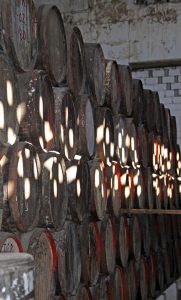
Forty nine years ago today, Black Tot Day was the last day on which the Royal Navy issued sailors with a daily rum ration, which was known as the daily tot.  The move was not popular with the ratings despite an extra can of beer being added to the daily rations.  On July 31 in 1970 the final tot was poured as usual at 11am after the pipe of “Up Spirits”.  Some sailors wore black armbands, others went through a ceremony of ‘burying at sea’ their tot of rum while at HMS Collingwood, the navy training camp in Hampshire, they held a mock funeral procession complete with black coffin and accompanied by drummers and piper.

The daily tot was a long-standing naval tradition.  In the seventeenth century English sailors were allocated a gallon of beer a day but there was a problem with storing so much liquid aboard ships.  In 1655, therefore, sailors were offered a half pint of rum instead and rum quickly became the drink of choice.  Due to increasing problems with drunkenness on ships the ration was set in naval regulations in 1740 so that the rum was mixed with water on a 4:1 ratio and split into two servings per day.
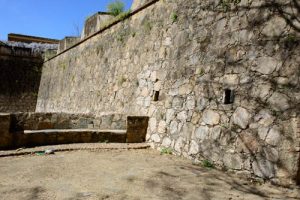
There were ongoing disciplinary problems in the navy which led to the tot being halved to a quarter pint in 1824.  In 1850 an Admiralty committee, delightfully known as the “Grog Committee” recommended that the daily tot be abandoned but the navy resisted, simply halving it again to an eighth of a pint a day to be served only in the morning.  The ration was withdrawn from officers in 1881 and warrant officers in 1918.

In the 1960s questions were asked in Parliament about the continuing practice.  The navy had changed and the Admiralty finally issued the following written statement:

“The Admiralty Board concludes that the rum issue is no longer compatible with the high standards of efficiency required now that the individual’s tasks in ships are concerned with complex, and often delicate, machinery and systems on the correct functioning of which people’s lives may depend”.

A debate in the Commons followed and it was decided that the rum ration should be withdrawn.  This historic event was marked by a stamp issue available from Portsmouth General Post Office, with the slogan “Last Issue of Rum to the Royal Navy 31 July 1970”.  Black Tot Day arrived and the navy mourned the death of one of it’s traditions.

Alcohol was also issued to serving soldiers in the army.  Part of the daily ration during the Peninsular War was listed 5 pints Small Beer, or 1 pint Wine, or ½ pint Spirits.  Women who were officially on strength were issued with half rations but no alcohol.  As with the navy, drunkenness was very common in the army and was responsible for a breakdown in discipline on many occasions.

One of the most shocking of these was the sacking of Badajoz in 1812 when the British army ran wild in the town for three days, ignoring all orders and looting, murdering and raping at will.  A big part of this horrific incident was probably due to drunkenness as the wine shops and cellars of the town were the first to be looted.  When some officers tipped over the wine pipes in an attempt to limit their soldiers drinking, the men lay down in the street and drank the wine from the gutters.

The ending of alcohol being issued to the army seems less well documented than Black Tot Day and less formalised.  There was still a regular issue during world war one but as far as I can discover the custom seems to have petered out rather than being subject to a formal parliamentary debate, although if anybody knows differently, do let me know because I’m curious.

These days there is something faintly shocking about the fact that the British army and navy encouraged alcohol use to such a degree but in past times it would not have been seen as a bad thing providing it did not affect their ability to do their duty.  Writing about these times, I am aware that beer and wine were often safer to drink than polluted water and heavy drinking was common in civilian life as well.  Doctors and surgeons used alcohol as a painkiller and sleep aid as well as an anaesthetic and had no notion that it was a bad idea.

Personally I think that a tot of rum at 11am every day would send me to sleep for the rest of the day but there is no doubt that back in 1970 a lot of ratings would have echoed Captain Jack Sparrow’s horrified question…

“Why’s the rum gone?”


The Battle of Talavera, 1809

Sir Arthur Wellesley, later the Duke of Wellington

The Battle of Talavera was fought on this day in 1809 near the town of Talavera de la Reina in Spain.  Sir Arthur Wellesley, fresh from his highly efficient victory at Oporto took 20,000 British troops into Spain to join General Cuesta’s 33,000 Spanish troops.  They marched up the Tagus valley to meet a French army some 46,000 strong, officially commanded by Joseph Bonaparte but actually under the command of Marshal Victor and General Sebastiani.
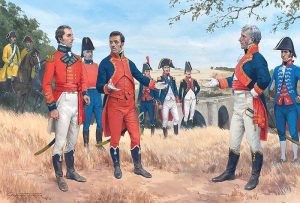
Wellesley did not do well in his attempts to cooperate with Cuesta.  Not for the first time, the British army found that their Spanish allies were unable to come up with the supplies and transport they had promised.  It is not clear whether this was negligence, inefficiency or simply that the supplies were not available, but it left Wellesley’s army in a difficult position with food running out.  In his negotiations with Cuesta, there was a language difficulty as Wellesley did not speak Spanish and Cuesta spoke little English and refused to speak French.  It is possible there was also a simple clash of culture as Wellesley fumed at what he perceived as inactivity and poor planning on the part of the Spanish.

Nevertheless, some agreement was reached and after days of delay and misunderstanding there was a clash between the French and British armies on 27th July which led to 400 casualties in Donkin’s brigade.  To add to Wellesley’s mistrust of his Spanish allies there was a farcical episode during the evening of the 27th when Cuesta’s men fired a volley without orders at some French dragoons.  Little damage was done to the French but four Spanish battalions dropped their weapons and fled in panic.  Afterwards Wellesley wrote:

“Nearly 2,000 ran off on the evening of the 27th…(not 100 yards from where I was standing) who were neither attacked, nor threatened with an attack, and who were frightened by the noise of their own fire; they left their arms and accoutrements on the ground, their officers went with them, and they… plundered the baggage of the British army which had been sent to the rear.”

Cuesta, deeply embarrassed, sent cavalry to bring the troops back but it did nothing to improve relations between the British and the Spanish.

During the night, Marshal Victor sent three regiments up the hill known as the Cerro de Medellin.  Two of them got lost in the dark but the third managed to surprise a brigade of the King’s German Legion which had gone to sleep, apparently believing that they were the second line instead of the first.  In a chaotic action in the darkness on the hilltop, General Rowland Hill sent in Stewart’s brigade from the second division to recapture the ground and the French retreated.

At dawn the French artillery began firing, and Wellesley was obliged to pull his men back into cover to avoid major casualties.  Ruffin’s division attacked the Cerro de Medellin again in column but the British emerged from cover in line and the French were broken by musket volleys and ran.

After an informal truce when dead and wounded were removed and the French leaders consulted Joseph Bonaparte, a frontal attack was launched against the British 1st and 4th divisions, once again in column.  They were routed by the Guards brigade but the Guards pursued too far and ran into the French second line, losing 500 men to artillery fire.  Wellesley realised that his centre was broken and brought up the 48th foot to fill the gap in his lines.  Mackenzie’s brigade joined them and the French attack was pushed back again, with Lapisse mortally wounded.

In the fictional version of the battle, described in An Unconventional Officer, Major Paul van Daan’s battalion of the 110th fought as part of Hill’s division and were involved in the night battle on the Cerro de Medellin and then in the centre battle.  Several field hospitals were set up in and around the town of Talavera, some of them using convents and monasteries and it is in one of these that Anne Carlyon worked as a volunteer alongside Dr Adam Norris as the wounded were brought in.

With his main attack defeated, Victor sent Ruffin’s men into the valley between the Medellin and the Segurilla.  Anson’s cavalry brigade was sent to push them back but an undisciplined charge by the 23rd light dragoons ended in disaster in a hidden ravine.  The French had formed squares and fought off those cavalry which had managed to negotiate the hazard with considerable losses among the British and Germans.

It was the last French attack of the day.  Joseph and Jourdan chose not to send in their reserve and during the night the French melted away leaving behind 7389 dead, wounded and captured soldiers.  Allied losses were worse over the two days with the British losing 6268 dead and wounded and the Spanish 1200.  Wellesley lost approximately 25% of his forces and in a final horror, wounded men from both sides burned to death when the dry grass of the battlefield caught fire.

Meanwhile, Marshal Soult was moving south, in an attempt to cut Wellesley off from Portugal. Wellesley initially believed that Soult’s had only 15,000 men and moved east to block it but Spanish guerrillas intercepted a message from Soult to Joseph confirming that Soult had 30,000 men.  Fearing that his line of retreat was about to be cut by a larger French force, Wellesley sent the newly arrived Light Brigade on a mad dash for the bridge at Almaraz.  Craufurd’s men arrived just ahead of Soult and Wellesley withdrew his army across the mountains and organised his defence of Portugal.  His hard fought victory brought him the title of Viscount Wellington of Talavera.

Historians disagree about Wellesley’s problems with the Spanish.  Some consider the campaign a failure despite the victory and cite the failure of the Spanish to supply Wellesley’s army as the reason.  Wellesley certainly believed that the Spanish made promises which they failed to keep.  However, the condition of Spain at that time may well have made it impossible to provide the necessary food and transport and the personal difficulties between Cuesta and Wellesley certainly did not help.  There were also political rumblings, with suggestions that Wellesley might be given control of the Spanish army and Cuesta was undoubtedly upset by the idea although it does not seem that it originated from Wellesley himself.  Wellesley was cautious from the start about his Spanish adventure, citing the fate of Sir John Moore’s army during the campaign of 1808 and his determination not to allow his route back to Portugal to be cut off made him wary.

On the whole, it was probably not the time for an all out invasion of French-controlled Spain.  Wellesley’s original brief had been to defend Portugal but his army was not yet the formidable fighting force which he later led to victory at Salamanca and Vitoria.  The severity of his losses made his retreat a sensible choice and the time he spent consolidating in Portugal put him in a far better position to resume the campaign.

Jewish Museum in Berlin

Jewish Museum Berlin

jewish-museum-377351_1920-2

Jewish Museum in Berlin, August 2017 – a review by Lynn Bryant

The Jewish Museum in Berlin was one of a list of places we wanted to visit while we’re here, and it just happened to be the first we picked.  We had several other places on that day’s itinerary and we made it to none of those because the Jewish Museum kept us going all day long.

The buildings themselves are fascinating.  The entrance is in the Collegienhaus, the last baroque palace in the Friedrichstadt area of Berlin, a protected building in it’s own right.  Once inside, the permanent exhibitions are housed in the Libeskind  building, which zigzags with a titanium zinc facade and is open to interpretation as to what Daniel Libeskind, the American architect intended to represent.

I found the building itself slightly disturbing.  For some reason I felt at times as though I had become caught in an Escher maze with a bewildering variety of levels, sloping floors and unexpected corners.  The building itself seems to be part of the exhibitions, demonstrating the sense of displacement and confusion of the history of Jewish people in Berlin.  But it isn’t the building that I will remember in years to come.  It is the variety, the depth and the sheer volume of the information contained in the exhibitions.

The various galleries take the visitor through the history of the Jews in Germany from earliest mentions through to thriving communities in towns and cities.  All to often these were disrupted by violent pogroms where people were killed, tortured and driven into exile.  The impressive thing about the German Jewish community, looking at some of the episodes in it’s history, is that it survived as well as it did coming into the twentieth century.

How many people know about Gluckel of Hameln who was a Jewish businesswoman and diarist in the late seventeenth and early eighteenth century?  Anyone?  I certainly didn’t, but the section devoted to her is completely amazing, with maps showing not only her business interests but the way she married off her many children to advantage.  Her story is definitely on my list to read, she is a woman I could write about.

The story of the rise of Hitler, the holocaust and the subsequent fate of the Jews in Europe is very well known.  Married to a Jewish man, I always find exhibitions like this very moving and at times quite distressing.  This one covered not only the events of the war but some of the war crimes trials which followed it.  Most of this was already known to me which did not make it any less interesting or emotional.

What I didn’t know was very much about the history of German anti-Semitism through the nineteenth century and early twentieth century.  Reading the long list of events and acts against Jewish inclusion into German society I was slightly shocked.  At the same time, I felt as though it put the rise of the Nazis into perspective for me as nothing else had.  Suddenly it became very clear how Hitler was able to tap in to this traditional suspicion of the Jews to create the scapegoat he needed.

faces-986236_1280

This museum hid nothing and excused nothing and held nothing back and I have an enormous respect for it’s honesty.  There is so much there, we quickly gave up any idea of moving on to other museums, went for a break in the cafe and then returned to do the rest of the exhibition properly and it was well worthwhile.  Everything is translated into English, films and visual exhibits have English subtitles and there is a very good audio guide which can be borrowed.  I came away with a strong sense of having learned a lot about a subject that I thought I knew fairly well and that is always the sign of a good museum for me.

A bonus was the temporary exhibition entitled Cherchez la Femme which presented a wide range of ideas and views regarding women’s head and body coverings in both a religious and secular context.  The exhibition looked at historic and modern day attitudes in various religions and gave a balanced and often provocative view of how much choice a woman has over how she dresses depending on where and how she lives.  It was completely fascinating and one of the highlights of the museum, genuinely causing me to rethink some of my own positions on this.

This was one of the best museum visits I’ve had in a very long time.  I’ve now got a long list of new subjects to research and read about and a lot of new ideas burbling around in my brain.  And it was only day one of our trip.  I was worried I’d be exhausted by day three…


WordPress Appliance - Powered by TurnKey Linux