Jewish Museum in Berlin, August 2017 – a review by Lynn Bryant
The Jewish Museum in Berlinwas one of a list of places we wanted to visit while we’re here, and it just happened to be the first we picked. We had several other places on that day’s itinerary and we made it to none of those because the Jewish Museum kept us going all day long.
The buildings themselves are fascinating. The entrance is in the Collegienhaus, the last baroque palace in the Friedrichstadt area of Berlin, a protected building in it’s own right. Once inside, the permanent exhibitions are housed in the Libeskind building, which zigzags with a titanium zinc facade and is open to interpretation as to what Daniel Libeskind, the American architect intended to represent.
I found the building itself slightly disturbing. For some reason I felt at times as though I had become caught in an Escher maze with a bewildering variety of levels, sloping floors and unexpected corners. The building itself seems to be part of the exhibitions, demonstrating the sense of displacement and confusion of the history of Jewish people in Berlin. But it isn’t the building that I will remember in years to come. It is the variety, the depth and the sheer volume of the information contained in the exhibitions.
The various galleries take the visitor through the history of the Jews in Germany from earliest mentions through to thriving communities in towns and cities. All to often these were disrupted by violent pogroms where people were killed, tortured and driven into exile. The impressive thing about the German Jewish community, looking at some of the episodes in it’s history, is that it survived as well as it did coming into the twentieth century.
How many people know about Gluckel of Hameln who was a Jewish businesswoman and diarist in the late seventeenth and early eighteenth century? Anyone? I certainly didn’t, but the section devoted to her is completely amazing, with maps showing not only her business interests but the way she married off her many children to advantage. Her story is definitely on my list to read, she is a woman I could write about.
The story of the rise of Hitler, the holocaust and the subsequent fate of the Jews in Europe is very well known. Married to a Jewish man, I always find exhibitions like this very moving and at times quite distressing. This one covered not only the events of the war but some of the war crimes trials which followed it. Most of this was already known to me which did not make it any less interesting or emotional.
What I didn’t know was very much about the history of German anti-Semitism through the nineteenth century and early twentieth century. Reading the long list of events and acts against Jewish inclusion into German society I was slightly shocked. At the same time, I felt as though it put the rise of the Nazis into perspective for me as nothing else had. Suddenly it became very clear how Hitler was able to tap in to this traditional suspicion of the Jews to create the scapegoat he needed.
faces-986236_1280
This museum hid nothing and excused nothing and held nothing back and I have an enormous respect for it’s honesty. There is so much there, we quickly gave up any idea of moving on to other museums, went for a break in the cafe and then returned to do the rest of the exhibition properly and it was well worthwhile. Everything is translated into English, films and visual exhibits have English subtitles and there is a very good audio guide which can be borrowed. I came away with a strong sense of having learned a lot about a subject that I thought I knew fairly well and that is always the sign of a good museum for me.
A bonus was the temporary exhibition entitled Cherchez la Femme which presented a wide range of ideas and views regarding women’s head and body coverings in both a religious and secular context. The exhibition looked at historic and modern day attitudes in various religions and gave a balanced and often provocative view of how much choice a woman has over how she dresses depending on where and how she lives. It was completely fascinating and one of the highlights of the museum, genuinely causing me to rethink some of my own positions on this.
This was one of the best museum visits I’ve had in a very long time. I’ve now got a long list of new subjects to research and read about and a lot of new ideas burbling around in my brain. And it was only day one of our trip. I was worried I’d be exhausted by day three…
Wellington had initially taken up a reasonably strong position on the line of the Dos Casas, a tributary of the Agueda River. Although the stream itself was insignificant, the section in front of the Allied left ran through a significant ravine that would effectively prevent any French attack on this part of Wellington’s troops. His right was not as strong. As the Dos Casas climbed into the hills the valley was less pronounced and provided less protection. The British position ended at the village of Fuentes de Oñoro, which climbed up from the river to the top of the ridge, and was itself a very defensible position. To the south, however the ravine disappeared and it would be very possible for the French to outflank the British. With his troops in preliminary positions, Wellington summoned the three light division commanders. “They’re on their way,” he said without preliminaries. “Marching down from Ciudad Rodrigo. We’ll see where he places them and then look at our positions.” “If we get time,” Paul said. His commander eyed him with a forbidding expression. “Have you something useful to say, Colonel van Daan or are you just making sure we all know that your new command is not going to stop you questioning my orders any time you feel like it?” “Not questioning, sir, more of a comment. You already know we could have done with a bit more time, but we’ll manage. Where do you want us?” Wellington studied him and then gave a small grim smile. “Out on the road initially, give them a hard time as they approach. I’m sending out four cavalry regiments as well. No major engagements and don’t take any risks, I will need your men intact for this battle, we’re short enough as it is. Have you heard me, Colonel van Daan?” “Loud and clear, sir. Getting better at it all the time.” Wellington shook his head. “I can’t wait until Craufurd gets back, he approved this but that’s because he’s forgotten what you’re like. You’re going to give him a seizure.” “No, he’s easily as tough as you, sir, and I haven’t given you one yet.” Paul glanced at Drummond. “How do you want to do this, George?” Drummond looked at him and smiled slightly. “Was that an attempt at tact, Paul? Why don’t Beckwith and I take the north side and you bring up the south with the cavalry, the ground on that side will suit them better. We’ll meet back before Fuentes once they’ve made camp.” Paul nodded. “Sounds good. Sir, we could do with some fast riders to keep us in touch with each other. I can use some of my ensigns but frankly they’d be more use with their men…” “I’ll get Julian Sanchez to lend you some of his horsemen they know the countryside.” Wellington eyed the three men. “I thought Craufurd would be here in time for this. And he still might make it, he must be very close. Which is why I haven’t appointed a temporary commander.” There was a brief silence which extended and became difficult. Still nobody spoke. Paul took a deep breath. “I’m glad you shared that, sir, because I’ve been thinking you’d done that just to make my introduction to commanding a brigade more interesting.” Beckwith gave a splutter of laughter, and Paul glanced at Drummond and saw that he was smiling too. He turned his gaze back to Wellington and for the first time during the briefing there was genuine amusement in the blue grey eyes. “Colonel there are four of us here and not one of us is in any doubt that if something gets difficult out there you are going to start yelling orders without any thought for rank or protocol. I first saw you do it aged twenty-two at the battle of Assaye when you bullied poor Colonel Maxwell into going into battle ahead of orders and you had been promoted to captain at that point for approximately twenty-four hours. If that happens I trust Colonel Drummond and Colonel Beckwith to have the experience and common sense to judge for themselves whether to join you, ignore you or punch you, and they have my express permission to do any of those three. Get out of here and keep me informed.” From “An Uncommon Campaign’ by Lynn Bryant (Book Three of the Peninsular War Saga)
An Uncommon Campaign
The battle of Fuentes De Onoro took place at the beginning of May 1811. After the retreat from Talavera in 1809 and then the successful battle of Bussaco in 1810, Wellington had kept most of his army behind the lines of Torres Vedras and used the time to train and recruit and recover from the mixed fortunes of the Spanish campaign. The exception was the light division under the brilliant but irascible General Robert Craufurd, who spent the time guarding the border, constantly engaging the enemy in skirmishing, holding the line with men who were fast becoming the acknowledged elite of Wellington’s army.
Marshal Massena, unable to breach the formidable Anglo-Portuguese defences and unwilling to risk too many of his men trying, held on desperately in lands scorched and left bare by the retreating British. By early 1811 it was clear that he could hold out no longer. His army was starving and exhausted and the reinforcements he had asked for were nowhere in sight. It was time to retreat.
Initially, Massena hoped to make for the Mondego valley which had escaped Wellington’s scorched earth policy and where food might be found for his starving men. But the Anglo-Portuguese army were in hot pursuit and no way could be found across the river in time. Fighting a skilful and desperate rearguard action, Massena retreated back to the Spanish border.
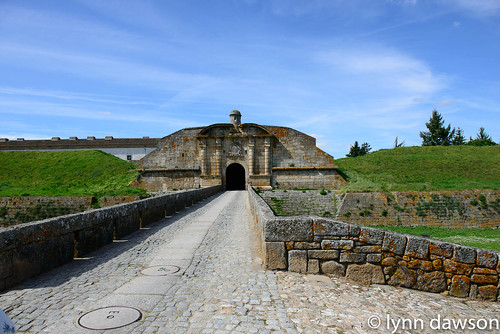
The Fortress at Almeida, Portugal
There were several great fortress towns along the Spanish-Portuguese border and in order to plan and execute an invasion of Spain safely, Wellington knew he needed to take possession of all of them. The most formidable on the Portuguese side was at Almeida, and it was the last stronghold in Portugal held by the French. Wellington besieged the city and Massena, his army finally fed and beginning to recover, marched to relieve it. Having surveyed the ground, Wellington chose to take up a position along a line running through the little Spanish village of Fuentes D’Onoro.
Supplies were crucial in this stage of the conflict. The French would have limited access to supplies whereas Wellington was well supplied and could hold out longer. He had the choice of leaving his line of retreat exposed in order to cover all routes to Almeida or of covering his retreat, which was usually his preferred option but giving the French a possible way through.
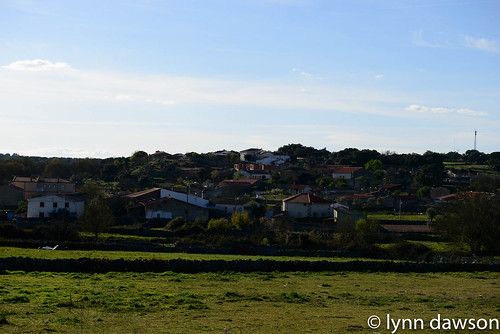
Fuentes D’Onoro was a cluster of buildings on a slope with narrow cobbled streets and walled gardens. It was well known to the men of Craufurd’s light division who had often been quartered there during their time on the border. Many of the villagers were known personally to them. With the people evacuated to a refugee camp, the British took up their positions. The Anglo-Portuguese army had 34,000 infantry, 1,850 cavalry, and 48 guns, while the French had 42,000 infantry, 4,500 cavalry, and 38 guns. Massena had asked for reinforcements from Bessieres in the north, and Bessieres had come himself but with so few men that the reinforcements were pointless. Wellington commanded six infantry divisions, Charles Ashworth’s independent Portuguese brigade, and three cavalry brigades along with some artillery.
On 3 May, Masséna launched a frontal assault against the British-Portuguese pickets holding the barricaded village, while bombarding the British-Portuguese on the heights east of the village with heavy artillery. The battle in the centre of the village went on throughout the day, with French soldiers of Ferey’s and Marchand’s divisions clashing with the British 1st and 3rd Divisions.
At first, the British-Portuguese were driven back under immense pressure, but a charge that included men of the 71st Highland Light Infantry reclaimed the streets and buildings lost earlier in the day. As the sun went down, the French withdrew and the village remained in British hands, with the former suffering 650 casualties against only 250 for the British.
Both sides spent 4 May recovering their dead and wounded from the streets of the village. An informal truce was held and men from the two armies met across the Dos Casas brook to exchange food and tobacco and play card games. When officers intervened, the French organised a series of intimidating parades to impress their enemy. The English played football.
Meanwhile, French reconnaissance had discovered Wellington’s weakness.
Fuentes de Onoro looking up from the French position.
His right flank was weakly held by a unit of Spanish partisans near the hamlet of Poco Velho. The French attacked at dawn on 5 May, concentrating on Wellington’s right flank where the Spanish crumbled. Allied cavalry held their positions with great courage but the 7th Division was left exposed. Masséna launched a heavy attack on the weak British-Portuguese flank, led by Montbrun’s dragoons and supported by the infantry divisions of Marchand, Mermet, and Solignac. Two 7th Division battalions were badly mauled by French light cavalry and Wellington needed to send reinforcements to save the 7th Division from annihilation. Defeat looked possible, but Wellington had reserves in place and he sent in Robert Craufurd’s light division along with British and German cavalry.
On the threatened British-Portuguese right flank, the elite Light Division, well supported by cavalry and artillery, made a textbook fighting withdrawal. With very few casualties, they covered the retreat of the 7th Division and fell back into a stronger position selected by Wellington. During the retreat, whenever French artillery ventured too close, the British cavalry charged or feinted a charge. This allowed the infantry time to retreat out of range. If the French horsemen pressed the outnumbered British cavalry back, the British-Portuguese infantry formed squares and, their volleys drove off the French.
It was an extraordinary display of military discipline and precision and a tribute to the genius of Robert Craufurd, who for all his reputation of a rude, over-sensitive disciplinarian who was disliked by many of his officers, could do anything with his enlisted men, who would follow him to hell and back for a word of approval. The skill of the light division and the courage of the highly outnumbered Allied cavalry saved Wellington, who had undoubtedly made mistakes that day, from what might have been a defeat, and brought instead a victory.
Church in Fuentes de Onoro.
Masséna’s main aim was still to secure Fuentes de Oñoro. He sent forward massed columns of infantry from Ferey’s division. The village, filled with low stone walls, provided excellent cover for the British line infantry and skirmishers, while the French were severely restricted in the little narrow streets. At first, the French had some success, wiping out two companies of the 79th Highland Regiment and killing the regiment’s commander, Lieutenant-Colonel Philips Cameron. But a counterattack chased Ferey’s men out of the town.
Memorial to the Battle of Fuentes de Onoro 1811
launched a second attack on the town. This time, it was led by three battalions of grenadiers. Again, the British fell back as Drouet threw in about half of the battalions from both Conroux and Claparède’s divisions, managing to take almost the entire town.
In response, Wellington counterattacked with units from the 1st and 3rd Divisions, plus the Portuguese 6th Caçadores and led by the 88th Connaught Rangers. This broke Drouet’s attack, and the tide began to turn. Low on ammunition, the French had to resort to the bayonet in a futile attempt to drive the British back. One party of 100 grenadiers was trapped in a tight spot and killed. Facing lethal volleys, the French retreated back to the Dos Casas, leaving their casualties behind. By sunset, French morale had plummeted and many companies were down to 40% strength.
The French artillery tried to bombard the new British line into submission, but for once they were outgunned by Wellington’s cannons. Finally, with their ammunition dangerously low, the French attacks came to an end. Wellington’s men entrenched during the evening. After spending the next three days parading before the British position, Masséna gave up the attempt and retreated to Ciudad Rodrigo, furious with his subordinates whose refusal to obey orders at crucial moments had turned a potential victory into a defeat which would spell the end of his command in the Peninsula.
The battle of Fuentes d’Onoro was not claimed by Wellington as one of his great victories. He had beaten back the French and was able to continue his blockade of Almeida. However, he acknowledged how dangerous the situation had been, saying later, “If Boney had been there, we should have been beat.” Wellington considered that he had unnecessarily extended his line, putting the 7th Division and Light Division in danger.
Two nights after Masséna’s withdrawal, Antoine Brenier’s 1,400-man French garrison of Almeida slipped through the British-Portuguese lines during the night. About 360 French troops were captured, but the rest escaped through a series of blunders. An infuriated Wellington wrote, “I have never been so much distressed by any military event as by the escape of even a man of them.”
On reaching Ciudad Rodrigo, Masséna was recalled to Paris by a furious Napoleon to explain his actions. He was replaced by Marshal Auguste Marmont. Masséna returned to France with a vast sum of gold, looted from Portugal and Spain. The defeated French marshal complained that Wellington “had not left him one black hair on his body—he had turned grey all over.” Later, meeting in France after the war, Wellington and Massena met as former adversaries and got on very well. On discussing their final campaign against one another, Massena said:
My Lord, you owe me a dinner – for you made me positively starve.” Wellington laughed. “You should give it to me, Marshal, for you prevented me from sleeping.”
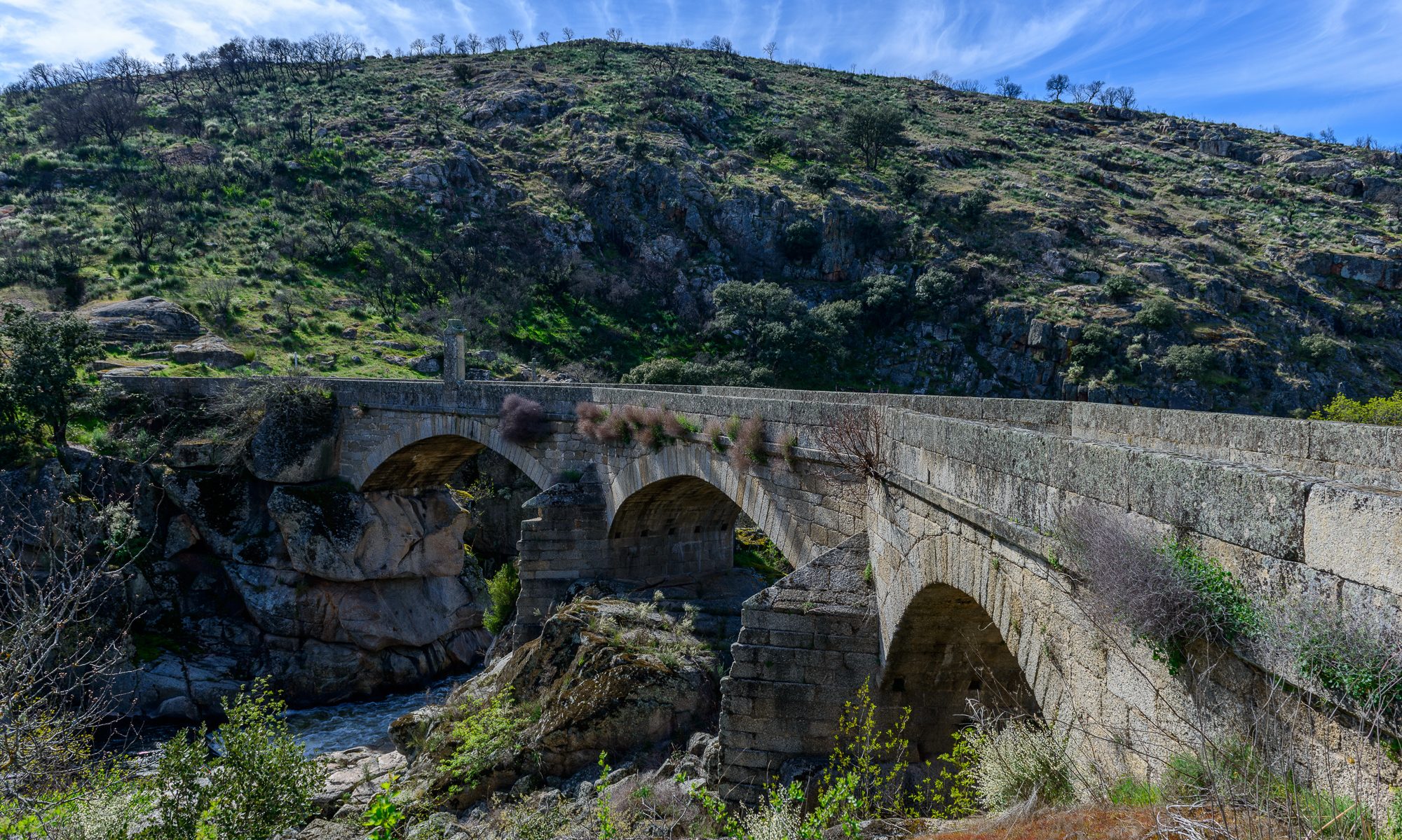
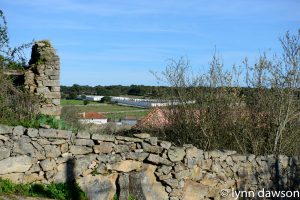
We visited Fuentes d’Onoro earlier this year. Despite being surrounded by modern roads it is surprisingly easy to see the layout of the very extended battlefield. The third book of the Peninsular War saga, “An Uncommon Campaign” is centred around the battle, and in particular the Light Division part in it, since by now Paul van Daan’s 110th are fighting as part of Wellington’s elite division. The first fourbooks in the Peninsular War Saga are available in both Kindle and paperback editions on Amazon.
An Unconventional Officer
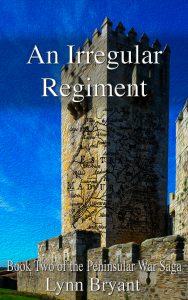
An Irregular Regiment
A Redoubtable Citadel
For regular updates and articles on history, travel, writing and life why not join the mailing list here
An Irregular Regiment, book two in the Peninsular War saga is available free on Amazon kindle for the next two days, while book one An Unconventional Officer is just 99p. Why not get both of them for your holiday reading.
The Peninsular War saga follows the story of Lieutenant Paul van Daan from his early days with the 110th infantry in India and on to Portugal and Spain under Sir Arthur Wellesley, later Lord Wellington.
Book one covers the period from 1802 when Paul joins the regiment as a young officer and follows his career and his personal life up to the eve of the battle of Bussaco in 1810. Book two takes up
Book 1 of the Peninsular War Saga
The books are thoroughly researched historical novels which tell the story of the men and women at all levels of army life during Wellington’s Peninsular Campaigns. They cover skirmishes and marches, campaigns and winter quarters, the bloody scenes of the battlefields and the even bloodier sights in the surgeons tents. They also tell a love story of an unusual couple in difficult times.
Two for the price of one. Why not give them a try?
Time management for authors is a subject close to my heart. When I decided to embark on a writing career I had the naive view that it was all about writing the books I love and then launching them on an unsuspecting and hopefully appreciative world.
Being an indie author is a somewhat different proposition. I find myself hopping from one activity to another like a somewhat manic flea at times, trying to fit in writing, revising, researching, marketing and cooking the occasional meal and doing the laundry.
I’ve come to the conclusion that organisation is the key and that starting to plan my days better would be a big help in getting things done and also ring fencing my writing time while keeping up to date with all the other things I’m trying to do. Naturally halfway through writing this paragraph I thought of three other jobs, completely essential, which I needed to go and complete before I finished this blog post. Like I said, it’s a work in progress.
However, I’ve been doing this for a few months now and I do think I’ve developed some idea of how to manage time better. This is obviously within the context of the other things we need to do. My other job is part time, running a dance school, so I need to fit in around that. I also have a home and family and one or two voluntary activities that I’d like to find time for. Some of you will be fitting in everything around a full time job. I’ve done that and it led to far too many three am writing sessions leaving me bleary eyed the next day, so I’m lost in admiration of people managing that one.
My guide, based purely on my own experiences, would run something like this.
Make a list of the roles you play. You’re going to want to allocate some time to each of them. They are not all equal and they will change. For example, my roles would include dance school owner, writer, mother, home manager, publicity and marketing person etc etc. Ten years ago the role of mother would have needed a bigger chunk of time than it does now.
Use lists. Even if you don’t do everything on the list, it helps to have a guide.
Don’t take on too much. Listen to me on this one. I am an expert at ignoring my own advice.
Let people help you. I’m so bad at this, it’s untrue.
Ring fence writing time. If you’re working at home you need to make sure people know that it is still working. And that can be hard.
Have time off. Writing might be the most fun you have all week but there is still a world out there and no job should be 24/7 or 365 days a year. Even if you’d like it to be.
Keep a diary or calendar. You will forget important things. I just lost my diary, I left it at one of our dance halls and it has vanished. I now need to put all my vital information into a new diary and I’m totally bewildered until I do that. Most normal people use an online diary but I’m strange and I like paper, whatever the disadvantages…
Set deadlines but make them realistic or you’ll die of stress. If you’re having deadlines set by other people, argue if you think they’re unrealistic. It’s worth it.
Don’t panic if you’re feeling overwhelmed. Take a deep breath and just do one thing. The rest will follow.
Keep computer use under control. The temptation to keep checking social media or e-mails is overwhelming. It wastes hours of the day. Give yourself a set amount of time and try to stick to it.
Use a timer. I got this idea a few years ago from an online home organisation site called Flylady. I have to say this site makes me laugh in places. There’s so much stuff on it that it’s mad and it’s all very cosy and very sweet and not always my sort of thing. BUT if you’re feeling overwhelmed and not sure how to get moving, I think it can be great. I still use some of the techniques I learned from it and the best one, if I’ve got too much to do and am about to explode, is using a timer and setting myself short bursts of activity.
Enjoy what you’re doing. If you’re a writer, you’ve got the most fun job in the world. Try to appreciate that…
Tynwald Day, the Manx national day, is held each year on July 5th and is a celebration of Manx independence and Manx culture. I wrote this post last year and am re-sharing it along with a free promotion of my most recent book, An Unwilling Alliance,which is set on the Isle of Man and in Denmark in 1806-7 and features a Manx hero and heroine.
Tynwald is the Parliament of the Isle of Man and no other parliament in the world has such a long unbroken record. It has been going since Viking times, more than 1000 years and governs a tiny island in the Irish sea. I had never heard the word Tynwald until I moved to the island fifteen years ago and I’m not sure I had really grasped the fact that the Isle of Man is an independent country with it’s own laws and its own Parliament. The island is not part of the United Kingdom, but a Crown Dependency with the Queen acknowledged as Lord of Mann.
The ceremony held atSt John’s on Tynwald Day has changed in the details but has basically been going on for more than 1000 years. Back then the island was a collection of Viking settlements and an annual sitting of their Parliament was held around midsummer where people gathered to hear their laws proclaimed aloud, to seek justice and to air their grievances.
The Vikings or Norsemen first came to Mann around the year 800AD, and ruled the Island for four-and-a-half centuries before finally ceding it to the King of Scotland in 1266. By then they had firmly imposed their own administrative system, which continued even while the Island’s ownership passed between Scotland and England, to the Stanley family of Lancashire (Lords of Mann from 1405-1736), and to their kin the Dukes of Atholl, who held it until it was re-vested in the British Crown in 1765. The custom of Tynwald Day has continued throughout all these changes.
On Tynwald Day, Tynwald meets at St John’s instead of the usual parliament building in Douglas, partly in the Royal Chapel of St John the Baptist and partly in the open air on Tynwald Hill, a small artificial hill nearby. The meeting is known as Midsummer Court and is attended by both branches of Tynwald, the House of Keys and the Legislative Council. The Lieutenant Governor presides as the representative of the Lord of Mann, unless the Queen or another member of the Royal Family is present.
All bills which have received the Royal Assent are promulgated on Tynwald day and if this does not happen within 18 months of passing the bill it ceases to have effect. Other proceedings can include the presentation of petitions and the swearing in of public officials. There is a formal procession which includes the Lieutenant Governor, Members of the House of Keys and of the Legislative Council, the Deemsters who are the highest judicial officers, any guests of honour from other nations, clergymen, leaders of local governments and any other state officials of the Isle of Man. Members of the general public attend the ceremony as do local constabulary and military. It is a highly formal affair.
Before Tynwald sits, the individual presiding inspects the guard of honour and lays a wreath at the National War Memorial. There is a religious service in the chapel at 11am and then Tynwald proceeds to the adjacent Tynwald Hill. The path is strewn with rushes following the celtic custom of pleasing the sea god Mannanan with bundles of rushes on Midsummer’s Eve. The path is lined with flagpoles, which fly the national flag and the parliamentary flag. The laws are proclaimed from Tynwald Hill which has existed from at least the end of the 14th century. Once this is done, Tynwald reconvenes in the Chapel and quill pens are used to sign certificates documenting the promulgation of the laws.
Once the captioning of the acts has concluded, the Lieutenant Governor and the Legislative Council withdraw, leaving members of the House of Keys for a session of their house. Once Tynwald Day is over there are three more sittings of Tynwald before the government adjourns for the summer until October.
Traditionally, Tynwald Day was marked by a fair and market; these customs still continue with stalls, demonstrations, music and dance throughout the day and on into the evening. The village of St John’s is packed with people and the following week, known as Manx National Week, usually hosts a series of concerts, displays and other events related to Manx culture.
For the first few years we were on the island it was an annual event to go to Tynwald Day. I admit I was fascinated by the history, the idea that this ceremony, in some form or another, has been going for so long. It is very different to the British opening of Parliament and Queen’s speech which is very much a Parliamentary event. This is an event for the people, and the tradition of people bringing their grievances before Tynwald on this day really happens, I know people who have done it. This year, as an example, several Manx women staged a silent protest dressed in Handmaid’s Tale type red cloaks and bonnets to show their support for reform of the island’s highly outdated abortion laws. Democracy moves slowly at times, but it does move and Tynwald Day is a traditional forum for protests like this.
The actual reading of the laws is long and boring and I’m not sure how many people really listen. But it’s an important part of the day. The officials are in full robes and wigs and there’s a real sense of ceremony and national pride.
I’ve not been to Tynwald Day for years now. It’s the day after my daughter’s birthday so it’s often difficult. But I think I’d like to do it again at some point. In the past, when the children were younger it was all about the fair and the activities and the market stalls. But I think I’d like to attend from the point of view of a historian, to read about the ceremonies of the past and feel the sense of continuity which shines through the day. The island is a small nation but has a deep sense of pride and community which I’ve a suspicion we could all learn something from.
Many thanks to Heather Paisley for use of her photographs.
For regular updates on this site including history, travel, book reviews and plenty of labradors (and a few freebies thrown in) please join the e-mail list here.
Independence Day is the national day of the United States of America, celebrated on the 4th July when the Declaration of Independence was adopted in 1776. It’s sheer coincidence that it is the day before Tynwald Day which is the national day of my adopted nation, the Isle of Man. It is also the birthday of my younger and most fiercely independent child which is possibly more a matter of fate than coincidence…
Thomas Jefferson
In fact, the Continental Congress declared independence two days earlier on July 2 but the declaration was debated and reworded, finally being approved on July 4. The thirteen colonies declared that they were no longer part of the British Empire and regarded themselves as a new nation. The principal author of the declaration was Thomas Jefferson. On 3 July, John Adams wrote to his wife Abigail:
“The second day of July, 1776, will be the most memorable epoch in the history of America. I am apt to believe that it will be celebrated by succeeding generations as the great anniversary festival. It ought to be commemorated as the day of deliverance, by solemn acts of devotion to God Almighty. It ought to be solemnized with pomp and parade, with shows, games, sports, guns, bells, bonfires, and illuminations, from one end of this continent to the other, from this time forward forever more.”
Independence Day Fireworks
Adams’ prediction was right about everything except the date. Americans chose instead to celebrate Independence Day on the day shown on the Declaration rather than on the date it was actually approved. The day is now a national holiday in the US with huge celebrations including fireworks, parties, picnics and barbecues. Local parades are often held in the morning and families gather to celebrate the long weekend.
I spent some time this week researching the origins of the Manx Tynwald Day without really thinking about the American equivalent, which is funny considering the different sizes of the two nations and two events. Surprisingly, though, there are some similarities in the fierce national pride which both nations take for granted. The Americans chose a date relating to the creation of their state for their national day; the Manx day was simply midsummer, the date when for over 1000 years their national Parliament met in the open air at St John’s to enact the laws passed during the year.
While I am not an advocate for the more aggressive forms of jingoism and the exclusive type of nationalism which can sometimes be associated with the Union Jack flag, I sometimes wish that the English had managed to come up with a national celebration which includes the entire country. We have more than our fair share of ceremonial but it tends to centre on London and the Royal family there and although there are occasional events which pull the country together like the 2012 Olympics and various Royal Jubilees, there is something to be said for a regular day where is is completely acceptable for a person to acknowledge their homeland and their pride to be part of it and it would be nice to feel it was celebrated throughout the UK in the same way that Independence Day is through America.
The Americans have been celebrating Independence Day for just over four hundred years. The Manx have been celebrating Tynwald Day for more than a thousand. It might be a small nation, but that’s what I call history…
I’ve just had a very odd experience. My fifteen year old daughter has just attended her year 11 high school prom and I found myself, for a short time, turning into ‘prom Mum’. It’s astonishing how much time and energy can go into preparing a daughter for this one event, lasting a few hours only. I’m not sure that I was looking forward to it but in the end it wasn’t as bad as I’d expected.
It wasn’t the first prom in the family. My son went through the process a couple of years ago but on that occasion my only involvement was to admire him in his suit and make sure the corsage matched his date’s dress. There was little else for me to do.
It’s different with a daughter, especially one like mine who does not conform to most teenage norms. I was frankly surprised that she wanted to do prom at all. Given her ambivalence, we rather left the whole shopping thing to the last minute, so we ended up travelling to buy the dress. Make up and hair needed to be decided and the location of the pre-prom and after-prom events took some arranging. But my child is fearsomely independent and apart from buying the dress I had less to do than many parents.
The high school prom is a custom which began in the United States but has been exported in recent years to the United Kingdom and Canada, probably because of the popularity of the prom in films and TV shows over the years. A rite of passage for high school students it has become an important ritual in the UK and most schools now have a version of it.
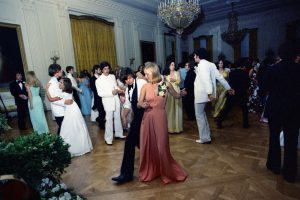
Susan Ford, who held her prom at the White HouseProm in the 1950s
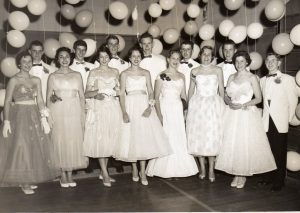
In the early days of prom in the United States, the dance was a bit like a debutante ball. It was considered the first adult social event for many teenagers and the first real occasion to dress up. Initially nothing more than an end of year dance, it gradually became an iconic episode in high school life and during the 1950s proms became more extravagant and elaborate. Original proms took place at the school but gradually it became more common to use hotels or country clubs. One lucky girl, whose father happened to be a President, held her prom at the White House.
The high school prom arrived in the UK during the 2000s. Before then schools often held a summer ball or end of year disco to celebrate the end of formal schooling but this did not have the significance of the US style prom. However, the increasing influence of US TV shows and movies changed the nature of these events and most schools now hold a year 11 prom and a year 13 prom to celebrate the end of schooling for these two year groups.
There is something reminiscent of a wedding about preparing for high school prom. Boys wear suits, girls wear evening gowns and there is a tradition of wearing a buttonhole or corsage of flowers. Traditionally students have attended in couples although it is increasingly common for groups of friends to attend together. There are formal photographs, parents often gather for pre-prom events and there is often an ‘after prom’ party which might be organized and supervised but is frequently not, in which case alcohol plays a part.
One of the traditions of prom is the election of a prom queen and king, voted in by the other students. Not all schools hold to this tradition and there has been some concern that it can lead to jealousy and spite but it has proved popular in many schools.
I was worried about the high school prom for my girl. I thought she might feel slightly out of place in the glitter and self absorption of the whole event. That says more about my view of prom than hers; I’ll admit to being a bit of a prom snob. To me it was an American invention wrapped up with teenage rivalry, too much make up and the prom king and queen being the two kids one would least want to spend an evening with. Clearly I watched too much American teen TV and movies over the past twenty years.
As so often happens, I was wrong. Prom queen and king were a couple whom my daughter declares to be totally sweet. She was nominated herself which she found hilarious. She had a date; a good friend of hers but most of her friends went as a group and there was no sense of rivalry or teenage angst at the pre-prom gathering. They were all happy, all enjoying dressing up in glamorous clothes and all delighted to be together.
Astonishingly I felt very emotional. I’ve known a lot of these kids since they were skinny little eleven year olds and they looked truly beautiful. According to my daughter, the evening was great, she danced until her feet hurt and so did everybody else. She got bored with the incessant photographs but was tolerant of them. She enjoyed herself at a good party where she got to dress up like a princess and be with her friends.
I don’t know if high school prom is always like this, but if it is, I’m a convert. I’m glad that my daughter had this rite of passage at the end of her compulsory education and I’m happy for her to do it again at the end of sixth form. It turned out that it wasn’t a popularity contest.
High School prom girls
The thing I really liked is that not once have I heard a single criticism or spiteful remark about anybody else. Nobody picked at each others hair or dress or make up. The kids I talked to seemed to have a genuine joy in being together for one last time before they separate to take their different paths. For my daughter it’s back to school for A levels; some are going to college or into work or apprenticeships. But on this evening they were all united and having a good time.
We here so much negative stuff about teenagers today. But this group, on this evening, at this prom, were a bunch of kids I’m delighted to know. Good luck to them all in whatever they do next. And just for one evening, I was a very very proud prom Mum…
The Bethnal Green Tube Disasterhappened on 3rd March 1943. 173 people died; men, women and children while trying to hurry down the steep steps to the station which was being used as an air raid shelter. Growing up in East London with a mother who lived through the Blitz as a child, I can’t remember ever not knowing about this tragedy. The story was told through my family and with grisly curiosity I can remember being quite young and asking about it time and time again as my mother insisted on holding my hand going down those steps on our way to the underground. So it was something as a shock to me to discover as an adult how many people in Britain have never heard of it at all.
The story, for me, follows on from my previous post about my childhood in London. There were endless stories of wartime Britain from my parents, grandparents and aunts and uncles. I’ve often wondered about the accuracy of some of them given how memories change over time. My mother is gone now as are all her brothers and sisters so I can’t ask for more detail and I wish I’d done it while I could. But the story of the tragedy in March 1943 was very real.
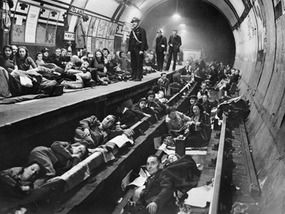
The winter of 1940-41 was a nightmare for Londoners, with the bombing pounding their city. On one occasion, London was hit for 57 nights in a row. In December firebombs hit the city. Air raid sirens were a constant background to daily life although there were many false alarms, but a lot of Londoners used to go into the shelters for the night just in case. Many had Anderson or Morrison shelters in their back gardens but they were cramped with no light, little air and no toilet other than a chamber pot. A lot of people preferred to use the Underground.
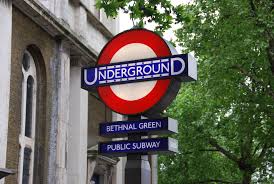
Bethnal Green was a new station as the Central Line had been extended from Liverpool Street in 1936, but work had been interrupted by the outbreak of War. With the track not yet laid, there was plenty of room with up to 5000 bunks. There was a sense of community with singing, laughter, tea urns and even a library and with bombs falling around them it must have given many a sense of security to be with their neighbours and friends.
Bombing was not as bad as it had been in previous years but on 3rd March 1943 it was expected to get worse as the RAF had bombed Berlin quite heavily two nights earlier and people were expecting reprisals. With the sound of the Siren and the closure of the cinema, 3 buses had just stopped nearby and their passengers dashed for the shelter. A woman carrying a baby tripped and fell as she went down the steps to the platform. A man tripped over her and a domino effect started. At the top of the stairs came shouted warning of bombs falling and when a new and loud sound was heard people thought it was a new kind of bomb although it was actually a new anti-aircraft rocket battery being tested in Victoria Park near by.
People panicked and pushed into the shelter unaware of the horror unfolding below them in the dark. The way was blocked but still people poured down. There were no handrails in the middle, no white edgings on the steps and no police on duty. It was dark and the steps were slippery from the rain. Around 300 people were wedged into the stairway – an area measuring approximately 15 x 11 feet. By the time they were pulled out, 27 men, 84 women and 62 children were crushed to death while 60 survivors needed hospital treatment. In a horrible irony there was no air raid or bombs dropped that night in the East End.
There was a government enquiry although it’s findings were not published until the end of the war to avoid propaganda for the enemy and damage to British morale. The entrance was poorly lit, with no central handrail and apparently the local council had asked permission to alter the entrance and put in a central handrail, but had been refused the funds by the Government of the day. After the tragedy new handrails were installed on the steps down to the station. Each step was marked with white paint.
The official statement by the Ministry of Home Security states:
“According to accounts so far received, shortly after the air-raid Alert sounded, substantial numbers of people were making their way as usual towards the shelter entrance. There were nearly 2000 in the shelter, including several hundred who had arrived after the Alert, when a middle-aged woman, burdened with a bundle and a baby, tripped near the foot of a flight of 19 steps which leads down from the street. This flight of steps terminates on a landing. Her fall tripped an elderly man behind her and he fell similarly. Their bodies again tripped up those behind them, and within a few seconds a large number were lying on the lower steps and the landing, completely blocking the stairway. Those coming in from the street could not see what had taken place and continued to press down the steps, so that within a minute there were about 300 people crushed together and lying on top of one another covering the landing and the lower steps.
“By the time it was possible to extricate the bodies it was found that a total at present estimated at 178 had died and that a further 60 were in need of hospital treatment. Statements from a large number of eye-witnesses and members of the police and Civil Defence services make it clear that there was no sign of panic before the accident on the stairs. No bombs fell anywhere in this district during the evening. Preliminary reports received by the Home Secretary and Minister of Home Security indicate that police, wardens, soldiers, W.V.S. and civilians worked hard and well to rescue the victims. Mr. Morrison has instituted the fullest inquiries to establish in greater detail what took place and to see whether any structural or administrative weaknesses have been brought to light”
The injured were taken to hospital in Whitechapel and the dead were taken to the mortuary there on carts and buses. When it became overcrowded the bodies were stored in St John’s Church opposite the tube station. Many of the victims were later buried in Tower Hamlets Cemetery, which was cleared by members of the Drapers Company with help from the Friends of Tower Hamlets Cemetery in time for the 60th anniversary. Others are buried in Manor Park Cemetery and a few elsewhere.
Because of the government’s desire to keep the tragedy quiet while war was still going on, those involved were told to keep quiet and not say what had happened. A report was filed by Eric Linden with the Daily Mail, who witnessed it but it never ran. The story which was reported instead was that there had been a direct hit by a German bomb. The results of the official investigation were not released until 1946. Everybody in the East End knew the truth but in the days without the internet and social media it did not filter out to the country as a whole. The press were silenced. There was no counselling in those days and PTSD wasn’t recognised. People were told to just get on with their life.
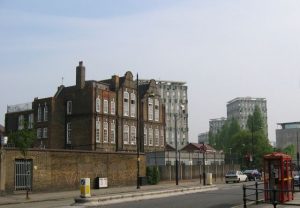
There is a list of the dead on the memorial website, and one of them was a twelve year old boy called James William Taylor. Jimmy was my mother’s first cousin, living within a few minutes of her and in the close knit community of the East End he attended Bonner Street School with her and her brothers and was a close part of her extended family. My mother and her brothers heard about the disaster from some other children on their way to school and were told that the bodies were being taken out and laid out on the pavement waiting to be transferred. With the grisly curiosity of wartime children they took a detour to see them. Only later did they find out that one of the hastily covered bodies laid out beside the road was their cousin Jimmy.
Thinking about this tragedy in light of the recent horrible events in London has made me realise how much times have changed. It is inconceivable to us that families, including children like my mother, were allowed – in fact expected – to cope with the reality of a tragedy like this without help or counselling or even without financial support. Women who lost their breadwinner in the tragedy faced hard times with their children.
Surprisingly my mother used to tell me that she remembered surprisingly little sense of outrage or anger at the government either for the disaster or the cover up. Perhaps that was because she was a child but also it was wartime and everybody had been taught that ‘careless talk costs lives’. There were no internet groups on Facebook to stir up anger and resentment and animosity, there was just the local community which offered comfort and support and practical help to those in need. What blame there was landed upon the local council since they were not allowed to publish their requests for funding to improve the entrance, given the number of people using it. But in wartime London, protests were fairly muted. People had other things on their minds and it was not until after the war that the full truth gradually emerged and public anger grew including a number of court cases.
For many years the only memorial was a small plaque on the stairway, the one which used to spark my curiosity as a child but in 2007 local residents, including many who had lost family in the tragedy and one or two survivors, formed a charity for a proper memorial to the worst civilian disaster of the Second World War. Their web page is well worth a look, as it tells the story in far more detail including very moving accounts of survivors.
The memorial, called A Stairway to Heavenis finally being unveiled on Sunday 17 December 2017. More than 70 years after the tragedy, those 173 people, including my first cousin once removed, are being remembered. Most of those who survived the disaster are gone now, but those who remain have never forgotten.
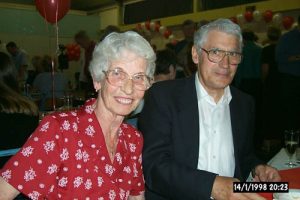
My mother didn’t spend all her childhood in London, she had two spells of evacuation, but she had vivid memories of the time she was there and she was a good storyteller. I’m going to write them down and perhaps get my sister and cousins to dredge up their memories of their parents’ stories. It’s very easy to think there is plenty of time. I wish I’d asked both my parents a lot more and written it down so that I could remember it more clearly.
As a history graduate and historical novelist, perhaps it should be my job to record the family history as well so that all our children can benefit from it.
Maybe it’s because I’m a Londoner was played at my mother’s funeral a few years back. It was very appropriate for her, because although for the last few years of her life she moved to the Isle of Man to be near us, she saw herself as very much a Londoner. She was fiercely proud of it, would defend London as the best city in the world – in fact the best place in the world – against anybody.
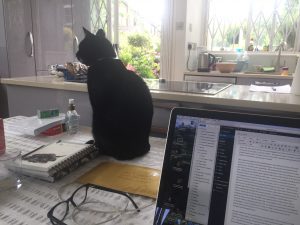
Monty the Cat
I was in London myself recently for a few days, cat sitting for a friend of my sisters and getting some quiet time after the complete madness of the past few months. It was as hot as Hades and I spent a few days with my sister catching up, being a tourist and getting sore feet after which she went home and I was alone and peaceful with Monty the cat. My intention wasto catch up on a lot of admin jobs that I’ve left for too long and then to get a really good way into my new Regency novel. It was a lovely flat with a balcony and the temptation to doze in the sun with Monty was huge, although I did try to resist.
It’s always odd being back in London. I’m not so familiar with this part, but we took a bus out through the East End where I grew up, to Stratfordand then went on to Canary Wharfand had lunch by the river. In my childhood, Stratford was our local shopping centre and Canary Wharf was a place we simply didn’t go – it consisted of rotting and boarded up warehouses with a few dingy businesses still struggling on. I’ve watched the evolution of docklands through my life and it’s been a fascinating process.
Despite being born and raised in the East End, I’m not really a city person. I don’t mind small towns; Douglasis about right for me. But I love the countryside and the coast, the feeling of fewer people and wider spaces and not feeling trapped. I don’t think I’d ever choose to live full time in a city again, especially a city as overcrowded as London now is.
Nevertheless – and maybe it’s because I’m a Londoner – I actually do still love London. It’s the place of my birth and my childhood. I love the history and the parks and the odd little corners that many people never visit. I was so lucky as a child to have parents who adored both history and walking. Every Sunday, unless the rain was torrential, we were dragged out to the number 8 bus stop at the end of the road, to “go for a walk”. This did not mean a twenty minute stroll through a park. It meant a four or five hour marathon through parts of London I would never have known existed.
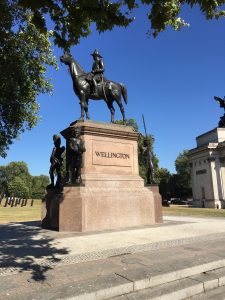
Wellington statue in London
We walked through theCity and listened to my mother’s stories of the blitz and of her first jobs in old fashioned offices, learning the switchboard and typing on an old fashioned typewriter. We wandered through the Inns of Courtand the world of legal London, with my Dad stopping to read every plaque on every wall. We discovered hidden gems like the Museum of the Order of St John and Postman’s Park. On wet days we did every museum in London including ones I’ve forgotten even existed. We went into obscure but beautiful churches which were always open to visitors back then, and if it was late enough in the day we would stay for evensong before getting the bus home. When people ask me why I write historical novels rather than any other kind, I find it hard to answer apart from to say I always loved history. But I know that this is why. At times, wandering through the ancient streets, I would whinge about the fact that my friends from school were all off ice skating or swimming or just hanging out in the street. But Mum was adamant that unless there was a genuine reason not to (like a broken leg – arms didn’t count, I once saw her scale the cliffs at Hastings with her arm in a sling) we would all go out together on Sundays. Church, Sunday lunch, walk or other outing and then home for tea and whichever series was on TV on Sundays. Saturdays were ours; on Sundays we belonged to her.
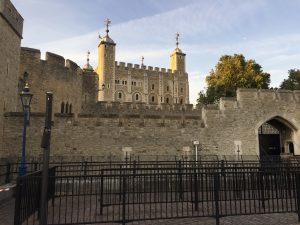
Tower of London
As I grew older the rule relaxed, but by then she didn’t have to nag me, I was hooked. At secondary school by then, I visited exhibitions relevant to whatever I was studying, sometimes with the school but sometimes on my own. I would think nothing – and still don’t – about taking myself off to the British Museumon a free day. A boat trip down to Hampton Courtor Greenwichwas a joy. I loved the Cutty Sark and the Tower of London – just wandering around outside them was enough. And I adored – and will always adore – theRiver Thames, where my parents did a lot of their courting.
All of this came from a family with very little. We lived, for the first thirteen years of my life, in an old rented house with no bathroom or indoor toilet. We washed in the kitchen sink and bathed in an old fashioned tin bath by the oil stove in the kitchen because there was no central heating. We ate healthily but with few luxuries on a daily basis although it made a meal out for a birthday or the extra treats at Christmas incredibly special.
When we moved to a council maisonette when I was thirteen, it was luxury. I can remember squabbling over who would be the first to use the new bath until we realised my mother was already in it. Curiously, we missed our old fashioned house; the new place had no garden. My parents were good managers and saved for their old age but we didn’t have that much stuff.
What we did have was experiences. We had one week’s holiday every year, always in the UK but always somewhere special. When we were small we went to holiday camps a lot as they were cheap and there was entertainment but as we got older we rented cottages and we explored Devon and Cornwall, the Lakes and Yorkshire, the Isle of Wight and parts of Scotland. We did it all by coach and bus and train; they had no car.
We went to the cinema to see every good new film going. We went to the London Palladium to see the Pantomime every Christmas. If there was a school trip to anywhere, they would find the money for us to go. My love of music came from endless school trips to concerts, the opera, and to hear Gilbert and Sullivan. My love of good plays and literature came from school trips to the Young Vic and Stratford upon Avon.They had never been abroad, but I went to Russia at sixteen with the school because my Dad did overtime to pay for it.
I’m aware as an adult of everything they did for us and everything they sacrificed so that we could absorb as many different experiences as they could afford to give us. It’s not that surprising that we both did so well. But I don’t think they thought it was that much of a sacrifice, I think they loved doing all these things with us, enjoyed introducing us to the city they both loved.
They were poor when we were young, got more comfortable as we grew up and travelled a bit more, spent more on themselves although they still never had a car or bought a house. They ate out a lot, discovered different cuisines and enjoyed it. They both still walked until arthritis and old age prevented them. But they never resented poverty or saw themselves as victims. They were never angry. They simply worked out what was important to them and what they could easily do without and if they needed more they worked a bit harder to get it.
They weren’t political although they never failed to vote, but they both voted on issues rather than blind loyalty to a party so at different times they voted for all three main parties. My mother voted for Margaret Thatcher simply on the grounds that it was time there was a woman in charge. She was a feminist without ever knowing what the word meant, or caring. My father voted Labour that year. Neither of them cared what anybody else voted. Their friends and family could be Labour or Tory or Liberal or nothing at all. It was considered rude to get personal about such matters as religion or politics. They were old enough to appreciate the welfare state, the NHS and any help they were given. They were gracious about it, didn’t see it as a right, said thank you when help was given. During the IRA bombings they continued to take us to all the same places, do all the same things. We missed the Ideal Home Exhibition bomb by a few minutes only, but there was no sense of anxiety. We were in London and that city belonged to us, not the bombers.
Maybe it’s because I’m a Londoner. But when I’m back here, no matter how much it has changed, no matter how much I know that I’d never come back to live here now, I still feel a very primitive sense of belonging. This is my city, my home, my childhood. I feel an enormous sense of familiarity and of love and gratitude both to the people who raised me and the city that shaped all of us. I’ve lived in many places now and loved a fair few of them. But when I come back to London, I know I’ve come home.
An Irregular Regiment, book two in the Peninsular War saga, is due for publication on 4th July.
The novel continues the story of Major Paul van Daan and the 110th infantry as they prepare to meet the French on the ridge of Bussaco in Portugal. Back on the battlefield only two weeks after his scandalous marriage to the young widow of Captain Robert Carlyon, Paul is ready for the challenge of the invading French army.
But Lord Wellington has another posting for his most difficult officer and Paul and Anne find themselves back in Lisbon dealing with a whole new set of challenges with army supplies, new recruits and a young officer who seems to represent everything Paul despises in the army’s views on discipline and punishment. Anne is getting used to life as the wife of a newly promoted regimental colonel as two other women join the regiment under very different circumstances. And an old adversary appears in the shape of Captain Vincent Longford whose resentment at serving under Paul is as strong as ever.
It’s a relief to return to the field but Paul finds himself serving under the worst General in the army in a situation which could endanger his career, his regiment and his life.
Given a brief by Wellington which requires him to use tact and diplomacy as well as his formidable fighting skills, it’s hardly surprising that the army is holding it’s breath waiting for Wellington’s newest and most explosive colonel to fail spectacularly.
Book 1 of the Peninsular War Saga
Read the first chapter of An Irregular Regimenthere. For those who haven’t read it yet, why not order an Unconventional Officer.












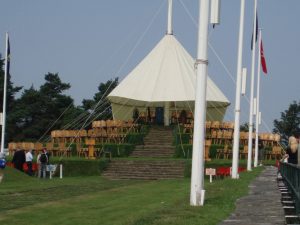
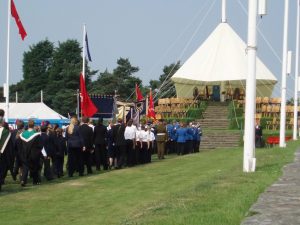 All bills which have received the Royal Assent are promulgated on Tynwald day and if this does not happen within 18 months of passing the bill it ceases to have effect. Other proceedings can include the presentation of petitions and the swearing in of public officials. There is a formal procession which includes the Lieutenant Governor, Members of the House of Keys and of the Legislative Council, the Deemsters who are the highest judicial officers, any guests of honour from other nations, clergymen, leaders of local governments and any other state officials of the Isle of Man. Members of the general public attend the ceremony as do local constabulary and military. It is a highly formal affair.
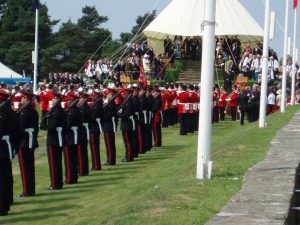 Before Tynwald sits, the individual presiding inspects the guard of honour and lays a wreath at the National War Memorial. There is a religious service in the chapel at 11am and then Tynwald proceeds to the adjacent Tynwald Hill. The path is strewn with rushes following the celtic custom of pleasing the sea god Mannanan with bundles of rushes on Midsummer’s Eve. The path is lined with flagpoles, which fly the national flag and the parliamentary flag. The laws are proclaimed from Tynwald Hill which has existed from at least the end of the 14th century. Once this is done, Tynwald reconvenes in the Chapel and quill pens are used to sign certificates documenting the promulgation of the laws.
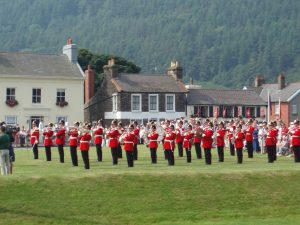 For the first few years we were on the island it was an annual event to go to Tynwald Day. I admit I was fascinated by the history, the idea that this ceremony, in some form or another, has been going for so long. It is very different to the British opening of Parliament and Queen’s speech which is very much a Parliamentary event. This is an event for the people, and the tradition of people bringing their grievances before Tynwald on this day really happens, I know people who have done it.
  This year, as an example, several Manx women staged a silent protest dressed in




 to daily life although there were many false alarms, but a lot of Londoners used to go into the shelters for the night just in case. Many had Anderson or Morrison shelters in their back gardens but they were cramped with no light, little air and no toilet other than a chamber pot. A lot of people preferred to use the Underground.
 the East End he attended Bonner Street School with her and her brothers and was a close part of her extended family. My mother and her brothers heard about the disaster from some other children on their way to school and were told that the bodies were being taken out and laid out on the pavement waiting to be transferred. With the grisly curiosity of wartime children they took a detour to see them. Only later did they find out that one of the hastily covered bodies laid out beside the road was their cousin Jimmy.
 As a history graduate and historical novelist, perhaps it should be my job to record the family history as well so that all our children can benefit from it.