
Welcome to Opening Night, my free A Bit Late For Halloween short story for 2026.
Those of you who follow these stories along with the adventures of the rest of the cast of the Peninsular War Saga and the Manxman Series will know that I generally post at least three short stories each year: Christmas, Valentine’s Day and Halloween.
Out of those three, I’ve struggled most with new ideas for Halloween. I love a good supernatural story but it’s becoming more and more difficult every year. Partly it’s because there are only so many ideas for this kind of tale. But it’s also that I like to use characters from my main series. That’s easy with the other two categories but it’s now stretching the limits of even my imagination to have too many of my characters having supernatural encounters.
I’ve decided therefore that this will be my last designated Halloween story. I’lla still do three stories a year but I’ll probably shift the timing of this one to some time in the summer without a fixed theme. That will space the three stories through the year much better and will also mean I have many more themes to choose from.
Having said that, there is definitely a spooky element to this tale and I did in fact write most of it on Halloween. It’s set in Regency London’s theatrical world and features a character I introduced in a previous short story called the Wedding. It also features a brief appearance from two very familiar characters.
The theatre is packed and the curtain is about to rise. Welcome to Opening Night.
Opening Night
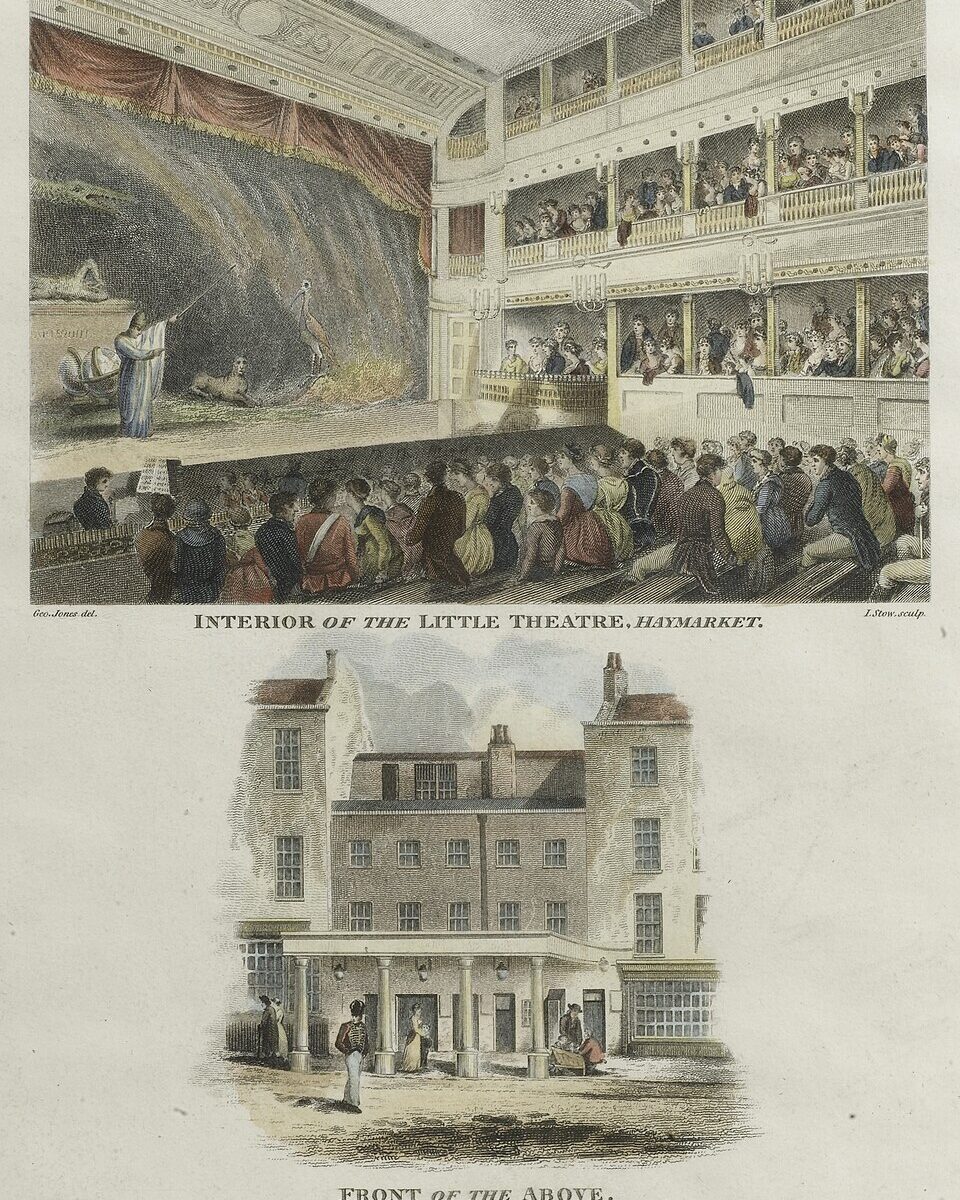
Little Haymarket Theatre, London, 1819
“This time next year none of this’ll be here,” the carpenter said in sepulchral tones. “Don’t seem right, like.”
The Theatre Royal’s newly cast Second Lady did not immediately reply. She was surveying the grimy cubby-hole which was to be her dressing room for the season. It was located between the timber uprights in the damp under-stage area, alongside storage racks for old scenery flats. It smelled of rotting wood and oil lamps, with a faint odour of smoke.
“It seems like an excellent thing to me,” she said. “I am astonished this ancient pile wasn’t pulled down years ago.”
The carpenter fixed her with a disapproving look. “The trouble with flighty young actresses,” he said, “is they’ve got no respect for history.”
“The trouble with grumpy old stagehands,” the actress said, “is that they live in the past. Is this thing safe, or is it going to fall in on me halfway through the quick costume change between the play and the farce?”
The carpenter reached out to rattle one of the elderly panels used to build the improvised dressing room.”
“Solid as a rock,” he proclaimed.
“Not any rock I’ve ever seen,” the girl said. “Where did you find all this junk anyway? It looks as though it’s been mouldering in a basement for half-a-century.”
“Probably has,” the carpenter admitted. “There was a warehouse sale over at Upper Thames Street. The Manager sent a few of us down to see what we could get cheap for making scenery and props. Picked up some useful stuff, but this was too badly damaged to be any good. Looks like it’s been in a fire somewhere.”
“Firewood is probably all it’s good for. All right, Rivers. You’ve done your best and if I don’t make it on stage to play the pert chambermaid at the recruiting inn, it’ll be because I’m lying crushed to death under here. At which point I’m going to come back to haunt the place because I’ll be furious that I never made it to female lead.”
Rivers grinned, showing a missing front tooth. “There won’t be nothing to haunt by next year, miss. They’ll have pulled it down and there’ll be colonnades, with shops selling elegant trifles to high society.”
“Then won’t they be surprised to see the ghost of an enraged young actress with a dent in her head from an old scenery flat? Get out of here, Rivers. I’ve only got half-an-hour before rehearsal and I want to run to Arbor’s to get some supper or I’ll starve.”
The carpenter bent to pick up his tool bag. “There’s some who thinks you’d get that lead role a lot sooner if you wasn’t too high and mighty to have supper with Mr Merriton, miss.”
“Is there a hammer in that tool bag?” the girl enquired cordially.
Rivers looked surprised. “Yes, miss. Have I left a nail sticking out or something?”
“No, I’d like to beat your brains out. And then I’ll hold on to it just in case Mr Merriton decides to visit me in my dressing room again. Anything else, Rivers?”
The carpenter laughed aloud and departed. Alone in her new accommodation, Miss Deborah Myers surveyed the ruined panels resignedly. Rivers had done his best and, although the improvised dressing room was not much bigger than a large cupboard, it seemed reasonably solid. The carpenter had put up three wooden hooks on the cleanest of the panels for Deborah to hang her costumes on and there was a small iron bolt on the inside of the makeshift door.
She had insisted on the door and the bolt and overridden Rivers’ grumbling objections about the extra work. This was Deborah’s first season as a leading member of the company but she had been in the chorus since she was fourteen, progressing from a dancer and ensemble singer to small speaking parts. She knew the danger of patrons, managers and actors trying to take advantage of an attractive young female and had more than once caught a man watching her around the curtain of an improvised dressing room. In a more modern theatre, Deborah might have expected to have a small dressing room to herself. She accepted the situation resignedly but had chosen to take a stand against wedging herself into the crowded ladies’ dressing room on the second floor. Terry had baulked initially then listened when Deborah proposed a solution. It was cheap and would inconvenience nobody, so he had instructed Rivers to find the necessary materials and give Miss Myers what she wanted. Once again Deborah had sensed a grudging respect.
Deborah knew she still had a long way to go to reach the dizzying heights of the leading lady but she had decided that she had reached a point where she could insist on privacy and had been pleased when the stage manager agreed. This shabby cubicle was not much, but it was hers and it felt like an important milestone. It was also a statement to Mr Thomas Merriton that however much he considered it his right as leading man to leer at young actresses he was not getting away with it with her.
She was running late and it was a scramble to buy supper from Arbor’s pie shop. She stowed the food in the bandbox she kept in the little changing room, hoping that the rats and mice that inhabited the theatre would not have time to chew through it. Rehearsals were supposed to be over by six-thirty but two days before opening night they tended to run later. Deborah rented a room above a wigmaker’s in a boarding house inhabited almost entirely by theatrical personnel. There were no cooking facilities although Deborah could heat water over the little fire in her attic room and Mrs Cooke would usually allow her to heat up her pie or pasty in the kitchen oven.
Rehearsals were exhausting and, this close to opening night, tempers were often wearing thin. The bill consisted of three pieces. The main piece was Sheridan’s The Rivals: a well-tried comedy in which Deborah played the second female lead. There was then a musical interlude, involving singing and dancing while the scenery was changed and those cast members in both pieces scrambled into their next costume. The afterpiece was a two-act farce in which Deborah played the overly forward maidservant at an inn which was used as an army recruitment centre. The piece was heavily based on The Recruiting Officer, a comedy which had been popular during the previous century. It had been adapted to make the jokes more obvious, and rather more vulgar, and to include both singing and dancing. Deborah preferred this part, as she was a talented singer and an excellent dancer and was keen to show off what she could do in this, her first full season as second lead.
By the end of the rehearsal, two of the dancers were in tears and Mrs Clement, the buxom leading lady, had stormed off stage after Mr Merriton had been rude about her delivery of her lines. Deborah wondered if her fury had more to do with Merriton’s wandering hands and tendency to deliver his own lines to the actress’s chest. Mrs Clements knew perfectly well no-one would listen to complaints about that and so might be making her point another way.
It was a relief to go back to her dressing cubicle and change into her own clothes. The theatre employed a shared dressing maid to help the female performers with costume changes but Deborah seldom needed to call on her. She was an expert in managing her own dressing as well as mending her own clothes. It made her popular with some of the other performers as she was always willing to make quick repairs to costumes if needed and her sewing was far neater than that of the wardrobe seamstress, who was often too drunk to manage a straight seam.
There was no mirror in Deborah’s little cubicle but a full-length one was situated at the foot of the steps leading up to the stage area so that performers could check their costume before heading up to the wings. Lighting was poor down here and not much better throughout the rest of the Theatre Royal. While other theatres had enthusiastically embraced the new gas lighting, the owners of this theatre, known affectionately as the Little Haymarket, were painfully clutch-fisted and still relied on oil lamps and candles both inside the auditorium and backstage. Many of the lights had already been extinguished and the theatre was growing quieter as performers made their way home to a late supper and cleaners and stagehands tidied up before doing the same.
Deborah did not want to be locked in by accident. She did not entirely trust old Farnworth, the night-watchman, to check the place was empty before blowing out the final lights, locking the doors and retiring to his cubby-hole to sleep through his shift. Still, she could not help pausing in front of the mirror to admire the trim, wine-coloured walking-dress and ivory spencer, topped with a neat straw bonnet which Deborah had trimmed with pale, silk-flowers to match. The outfit had been a surprise gift from a temporary employer during the lean weeks leading up to her current employment.
Deborah had spent several short periods in service, lying freely about previous employment and references. She had discovered that as long as she worked hard and did a good job, her employers seldom checked. On this occasion, she had initially taken a job as a parlour maid at a London house to tide her over. After that position fell through, she had made a wild gamble to get something else, which had led to a surprising offer of employment as a nursery maid at a country house in Leicestershire, until her theatre contract began.
Deborah had been dubious, but desperate, so had agreed sunnily to everything her new employer suggested. Her new employer had turned out to be nothing like any other member of the gentry that Deborah had worked for and she had never enjoyed a period in service more. At the end of the six weeks she was completely exhausted and almost sorry to leave. Lady van Daan chose to present her with her wages personally, which would have astonished Deborah had she not just spent six weeks working for this woman.
“Deborah, thank you. You’ve been a joy. You know that I took you on as a favour to Lady Rockcliffe but I’m very glad I did. The children are sad that you’re going and so are we.”
“I am too, ma’am. Or I would be if I wasn’t so excited about my new role. Thank you. You’ve been so kind.”
“No, I haven’t. I have worked you ruthlessly and you haven’t flinched. Here are your wages in full. As promised, I’ve also arranged your passage on the stage to London. An inside seat.”
“Thank you, ma’am,” Deborah said with real gratitude. “I’ll never forget you and the children. And the General, of course.”
“You will certainly never forget his language on the morning the roofer’s error caused part of the ceiling to come down in our bedroom. Your fortitude was remarkable.”
“So was the General’s language, ma’am.”
“There is a small bonus added to your wages. It isn’t charity; you thoroughly earned it. Hopefully it will enable you to find decent lodgings until you are paid.”
“Thank you ma’am. You’ve been the best employer I’ve ever had.”
“There is one more thing. I hope you won’t be offended. I wondered if you could find a use for these. Since we returned to England, the General has hounded me into ordering new clothing which is ridiculous because these are perfectly good and I only bought them three or four years ago. The gown and petticoats will be too long for you, but I know what a good seamstress you are thanks to your splendid work repairing the appalling tears in Francis’ and Grace’s clothing. The bonnet is almost unworn and the spencer is rather lovely with the gold embroidery. I think it will fit you perfectly.”
Deborah had tried the clothing on during her last evening in the Van Daan household and had almost cried at how perfect it was. Her dark hair and colouring was very similar to her employer’s and although she knew this was merely a casual gift of cast-off clothing which meant nothing to Anne van Daan, it almost felt as though it had been selected for her in terms of colour and utility. The gown proudly announced respectability and some level of previous prosperity; as though its owner’s years working in regional theatres and low-level London houses had been far more profitable than they had been. Deborah altered it to fit and wore it with pride.
Satisfied with her appearance, Deborah turned to make her way up the narrow stairway to the exit, then paused. As always, the old theatre smelled of candles and oil lamps, but now she thought she could smell something else. She could smell smoke.
Deborah sniffed the air. The stage manager for this season was Daniel Terry, a respected actor with many years of experience. Terry was an eccentric character, renowned for playing elderly curmudgeons on stage despite being no more than forty. He was an exacting manager who kept an exhausting schedule combining acting with management and he expected the same level of dedication from his staff. Deborah had seen him reduce performers to tears more than once. She had received her share of scathing criticism but was made of sterner stuff and had begun to think that it had earned her a grudging respect.
Terry was a martinet when it came to matters of safety backstage, particularly in the matter of naked flames. Fire was an ever present danger in theatres, especially in the Little Haymarket with its old-fashioned lighting and ancient, rickety structure. Theatre fires were not uncommon and, depending on when they happened, were often deadly. Elderly, wooden buildings, large amounts of flammable materials stored haphazardly, and a lot of people coming and going made accidents more likely. If the theatre was occupied at the time a fire broke out it could be difficult to escape. Staircases and corridors were always narrow; partly to save space but also to make it difficult for people to slip in without paying. During popular performances there was often overcrowding, with people wedged onto the benches in the pit or standing in the aisles. A sudden panic could be disastrous and Deborah had heard of people being crushed to death.
Under Terry’s rule, stagehands were supposed to regularly patrol the auditorium, the backstage area, and the upper dressing rooms; checking for fallen candles or unattended lamps. It was also the job of the night watchman to walk through the theatre once everyone had left to make sure all lights had been extinguished. Deborah knew the men were conscientious when there was any possibility of being surprised by Terry but she was not convinced that the night-men were as thorough once he had left for at the end of the day.
Deborah was not sure where the smell was coming from but she thought it must be from below the stage; where much of the space was given over to storage. She was the only performer to have a dressing room down here. There were big, shared dressing rooms on the upper floors, as well as a row of individual rooms for the star performers. Mr Terry had one of these, as did Mrs Clements and Mr Merriton. The other two were given over to Mr Charles Spencer, a willowy gentleman of around thirty who played the second male lead opposite Deborah, and Mr Adolphus Grant, a celebrated comedy actor of indeterminate age who brought sparkle to every part he played, while appearing to be permanently gloomy in real life.
She made her way back towards her dressing cubicle, stopping to collect a lantern from a hook on the stairwell. Whale oil was used for the glass Argand lamps which lit the theatre and it gave off a distinctive smell, especially at the end of the day when the lights were all extinguished. Deborah had worked in provincial theatres where the management bought the cheapest oil possible and the house smelled like a rather dubious fishmonger; but Mr Terry had apparently been firm about his unwillingness to work in such an atmosphere and the other leading actors had backed him up. There was still an odour but it was not unpleasant.
Rivers always left a few safety lanterns burning until the theatre was empty in case some dilatory opera dancer took too long changing and found herself stranded in the dark. Deborah made her way carefully by the dim light, trying not to stub her toe or catch her skirts on some abandoned prop or piece of scenery. One of the carpenters had injured himself several months earlier by stumbling over an abandoned pike left over from Hamlet. The thing was made out of wood but he had been badly bruised.
The smell of smoke seemed stronger as Deborah made her way back towards her cubicle and she began to feel anxious. She knew she had carefully extinguished the candle she had used earlier but, during rehearsal, this area was constantly busy with stagehands, carpenters and performers taking an unauthorised break and she doubted that everybody took the same care. She had left none of her personal possessions in the dressing room but her costumes hung there.
There was no sign of either smoke or flame as far as she could see. The cubicle was intact, the candles neatly put aside for tomorrow. Deborah made a careful circuit of the surrounding area but nothing seemed amiss. Now that she was here, the smell did not seem as strong. A thorough search convinced her that she must have imagined it. Either that or one of the crew had been enjoying a smoke and had quickly tamped out his pipe and disappeared from view.
Satisfied that the area was safe, Deborah turned back towards the stairs where she had left her bandbox. She had taken no more than a dozen steps when a voice said:
“Who’s that? What the devil are you doing down here? Step forward.”
Deborah’s heart had jumped at the unexpected sound and was still hammering. It was fortunate that she had recognised the voice, because if she had assumed it was Rivers or Farnworth she would have expressed her annoyance forcibly. She bit back the unsuitable words she had been about to utter and raised her lantern, coming forward.
Two men were approaching, one holding a similar lantern. Deborah had recognised the distinctive deep, gravelly voice of Daniel Terry. The other man was unknown to her; younger than Terry and rather taller so that he needed to stoop to avoid some of the lower beams. His face was partly in shadow but she had the impression that he was regarding her with an interested gaze. He wore full evening dress, which suggested that he was on his way to some dinner or other social gathering.
“What in God’s name are you doing wandering around down here?” Terry demanded. “I thought we had burglars. Or rats.”
Deborah was still jumpy enough to forget her usual deliberately respectful tone with senior members of the company.
“You must have thought it a very large rat if you confused it with a burglar,” she said.
“Don’t be impertinent,” Terry snapped. “Why are you down here?”
“I was on my way out and I thought I smelled something burning. I wanted to check. The lights had already been extinguished down here. I couldn’t find anything though.”
“And what were you doing wandering about below stage anyway?” Terry demanded.
“My dressing room is down here,” Deborah said indignantly. “Had you forgotten, sir?”
She added the last word because it had suddenly occurred to her that down here in the darkness she had forgotten to play the part of the grateful newcomer and was speaking as herself. Terry was glaring at her, his baffled expression suggesting that he had indeed completely forgotten the building of the dressing cubicle even though he had authorised it himself.
“Well you should be on your way,” he said finally, rather to Deborah’s relief. “Is that your box at the foot of the stairs?”
“Yes, sir. I put it down while I…”
“Well don’t leave it there again. Viscount Caerwyn nearly stumbled over it and broke his neck.”
Deborah opened her mouth to protest that she did not make a habit of leaving her possessions lying about; then closed it again with an effort. She had caught a surprised expression on the face of the other gentleman, which suggested that this was the first he had heard of his near-fatal accident on the stairs, but he said nothing.
Deborah dropped a little curtsy: not something she would normally have done to a fellow actor or stage manager however famous he was. Terry appeared to realise this. He opened his mouth to further express his displeasure, then stopped abruptly, staring at her.
“Do that again. Exactly as you just did. Including the over-pert facial expression.”
Deborah obeyed. Terry studied her for a minute. “I want you to include that in the afterpiece. We’ll go over it tomorrow at rehearsal. Don’t be late or you’ll be fined.”
“Have I been late once so far?”
Unexpectedly, Terry’s lips curved in a reluctant smile. “No. We’ll go over it at the dress rehearsal tomorrow. I’ll change your stage position so that the crowd in the pit gets the full benefit of that. They’ll be queueing up to see it again the following night. Good evening Miss Myers. Go away.”
Deborah contemplated another curtsy but decided not to spoil the effect. She had not done it to impress Terry but to make a point. The result had been unexpected.
As she turned to go, Terry said:
“I’m sorry, my Lord. I’ve no idea what she smelled, if anything, but I need to make a thorough check before I leave.”
“Don’t think of it, Terry,” Lord Caerwyn said. “I’ll be in my box tomorrow evening and I wish you a successful opening. I’d still like the tour; it would be good to see the rest of the old place before they tear it down. But it can wait. Goodnight.”
“Thank you, my Lord.” Terry paused. “Oh, Myers? If you see that useless oaf Farnworth wandering about upstairs, tell him to collect another lantern and join me.”
“Of course, sir.” Deborah crossed to the foot of the stairs and picked up her bandbox. It was undamaged, which meant her supper had been safe from rodents. The thought reminded her and she turned back. “Be careful of the rats, won’t you? There’s some awful big ones down here.”
She was at the top of the wooden stairs when she heard a peculiar noise behind her. Turning she realised that Caerwyn had followed her up. His face wore a pained expression and she wondered if he had genuinely stubbed his toe this time. Then he made a choking sound and she realised with some surprise that he had been trying not to laugh.
***
Viscount Caerwyn had been reprimanded many times about his sense of humour. For some reason, the reprimands had never really helped. During a distinguished army career he had never once failed in his duty, fought a duel, or done anything to impugn the honour of the regiment. It had often seemed unfair that in his younger days he got into more trouble than many of his fellow subalterns who did all of these things, simply because of his sense of humour.
It had begun as far back as Harrow. The Honourable Owen Rees had not been particularly scholarly but had a respectable career with none of the wilder pranks of some of his school mates. He had been flogged twice however; on both occasions the alleged crime had been impertinence. Owen knew that his actual crime was that he was unable to stop himself uttering some inappropriate comment even if it was to the Latin master. He had thought it funny at the time but the Latin master had disagreed.
The army had been easier and Owen had found himself popular with his fellow officers even if one or two of his seniors considered him disrespectful. He had only once been threatened with a potential affair of honour and he had managed to settle it with a civil apology and an excuse about having drunk too much. By then he was a lieutenant, hopeful of the opportunity to purchase up to captain, and his Colonel had sat him down for a serious conversation:
“You’re a damned good officer, Rees, and we need those. I don’t want to lose you. But if you don’t learn to close your mouth firmly when some ill-judged witticism comes into your head, somebody is going to shoot you. It may be me.”
Studying the young actress now, Owen had the curious sense that he had met a kindred spirit. He had watched her face during her encounter with the redoubtable stage manager and recognised that she was holding her tongue with an effort. He understood too that she had been unable to resist that last quip about the rats.
“It’s Miss Myers, I understand,” he said, controlling his laughter with an effort. “I don’t think I’ve seen you act before. I have to say that after that performance I’m very much looking forward to it.”
The girl eyed him warily. “Thank you my Lord,” she said finally. “If you’ll excuse me I should be getting along. I’ve not had supper yet.”
Owen could not decide if it was an invitation. If it was, he was not sure if he wanted to take her up on it. He was not in the habit of soliciting favours from actresses or chorus girls. When he attended the theatre it was because he genuinely enjoyed the play or opera. At the same time he felt an instinctive liking for this girl, probably because she had made him laugh. He compromised.
“I dined earlier at my club. I called in at the theatre because Mr Terry has been promising me a tour of the old building before they pull it down.”
“Or before it falls down of its own accord,” Deborah Myers said.
“A valid point. It will be a shame in a way. I remember my first visits to this place with my parents. But it’s definitely past its best.”
“I think it was probably past its best before you were born, my Lord, but then I’m the one with a changing room built out of old scenery flats under the stage.”
Owen laughed again. He was amused at the girl’s disregard for the difference in their social status. If she was flirting with him her methods were definitely original.
“Do you have far to go?” he asked. “I’m on my way to a reception in Picadilly but I could escort you.”
“I wouldn’t want you to miss your party, my Lord.”
Her voice was pleasant but firm and Owen decided she had not been trying to entice him. Perversely it made him even more keen to walk with her.
“These things go on all night. They won’t notice if I’m late. Please. I promise I have no intentions apart from to walk you home.”
Unexpectedly she gave a broad smile. “It’s seven minutes’ walk, just over in Cecil Court. You’d be hard put to manage a seduction in that time on a public street, sir.”
“It would take me much longer,” Owen said gravely. “I’m terrible at that kind of thing, honestly.”
This time she laughed. “Why not? Thank you. It will be a boost for my reputation to be seen walking with a Viscount.”
He grinned. “Then I hope we are seen by many people.”
“I don’t suppose anyone would notice. Just wait a moment. I need to go and kick Farnworth out of his cubby hole before Mr Terry realises he’s taking a nap and dismisses him.”
She disappeared behind the stage and Owen heard her raised voice chiding the night watchman. When she returned, he stood back to allow her to precede him through the stage door. It was a mild, dry night and the streets were busy. Owen fell into step beside her, managing not to offer to carry her bandbox because he had a feeling she would laugh at him. She went back to their interrupted conversation.
“Before I took this job I could never decide whether to encourage that kind of attention to boost my career or whether to keep away from it all. I wavered between the two, which must have been confusing for one or two gentlemen and several actors. But I recently spent time in a different place for a while and I’ve decided that I am worth more than that.”
“A different place?”
“Just work. I needed to earn money before the season began. This is my first season as Second Lead you know. Before then it was the chorus and small speaking parts.”
“I was wondering why I hadn’t seen you before. I go to the theatre a lot.”
“You probably have but you wouldn’t have noticed me in the chorus. I worked hard to get this but I had a few months without work before my contract started and I worked as a nursery maid for a while. It wasn’t anything I’d done before but they were good people Very good to me. I used to think the Quality were so high and mighty they’d look down on the likes of me but I’ve realised that some of them aren’t like that. It made me think better of myself. I’m an actress not a prostitute. I’m glad I had the chance to realise that before I did anything stupid.”
Owen was taken aback by her candour but she was so natural it was impossible to be offended. He found that he was smiling.
“I’m glad too. I predict a long and glittering career before you, Miss Myers. Does that mean I’m unlikely to see you in the Green Room if I happen to drop in?”
“Oh I’ll be there. I’ve only just been promoted to join the gentry in the Green Room and it’s a lot better than the cupboard I have as a dressing room. It’s not all laughs mind. Mr Merriton thinks it’s my job to grant him favours because he’s famous; Mr Terry sometimes looks at me as if he can’t remember who I am and Mrs Clements keeps giving me freezing looks because I’m ten years younger than her. But it’s where I’ll be because I earned it. They’ll get used to me in time.”
“I hope so.” They had arrived at the top of Cecil Court, a narrow lane running between St Martin’s Lane and Charing Cross. This was the heart of London’s theatrical district and the street was lined with associated shops and businesses: wigmakers, theatrical shoemakers, second-hand clothes dealers, and dressmakers.
“This is it,” the girl said. She indicated a tall, narrow house. “Mr Cooke is a theatrical wigmaker and his wife rents out rooms. We currently have two dancers sharing a room, a violinist from the orchestra, and a carpenter employed at Drury Lane who would like to marry me.”
Owen could not help laughing. “I see you are in very respectable company.”
“Well it’s clean and fairly priced and Mrs Cooke was a dancer in her younger days so she’ll never lock the door on us if the afterpiece runs late.”
“And the carpenter?”
To his surprise the girl gave a warm smile. “He is a nice man but we should not suit and I have told him so. He is some years older than me and I would drive him mad. Thank you my Lord both for your escort and for being a perfect gentleman.”
She favoured him with a rendition of her pert curtsy and a devastating flash of dark eyes under long lashes before disappearing down a passage to the side door. Owen stood looking after her, smiling. He reflected in some amusement that, ironically, this would be the first time he had ever considered inviting an actress to have supper with him and she had turned him down before he had asked. He liked her for it. He was also looking forward to seeing her opening performance.
***
Mrs Clements was furious at the changes to Deborah’s part in the farce. Deborah wondered if Daniel Terry had known what her reaction would be. If he regretted his decision, he gave no indication of it. He gave the leading lady a courteous hearing for approximately five minutes, then interrupted her.
“I’m sorry you’re so offended, Susannah, but I’ve made my decision and I’m standing by it. It shouldn’t inconvenience you at all. In fact, I’ve made no changes to your part so you’ve nothing new to learn. I had the idea yesterday and I asked Miss Myers to try it out for me backstage. I think it works very well.”
“You are giving that … that amateur, stage precedence over me. She will be flaunting herself in front of the lights, standing between me and the audience.”
“No, she’ll be to the side of you. You’ll be trying to keep out of sight while you’re listening to what Captain Barker is saying to Major Grim. It’s a simple piece of stage business and an extra line of dialogue. Places please.”
Deborah stood in the wings trying to ignore the older woman’s basilisk glare. She was well aware that, after this, Susannah Clements would drop any pretence at being pleasant to the newcomer. She had been willing to play the role of mentor to a younger woman but not if there was any chance that Deborah was being favoured by the stage manager.
In theatrical tradition, Clements had a point. It was the stage manager’s job to set the scene and manage the mechanics of the stage. He planned entrances and exits, choreographed the movements of the various extras, organised the scene changes, and coordinated musical cues with the leader of the orchestra. He was in charge of every rehearsal. What he did not do was tell the leading players how to act their part.
This was in the hands of the actors themselves. They had learned their craft through years of miserable provincial bookings or summer touring. It was usually left to them to tell the other players where to stand and the coveted place by the footlights at the front of the stage belonged to them. Deborah knew her part and made no attempt to draw attention away from Clements. Her respectful behaviour had made a harmonious relationship possible, at least on the surface.
Now however, Terry was breaking an unwritten rule. The curtsy, the extra line and the upswept glance at the two gentlemen in military dress, was perfect comic timing and both Merriton and Spencer responded without needing stage directions. Two minutes later Deborah was off stage again and Mrs Clements owned the limelight once more. All the same, Terry had given his new actress a golden opportunity to stand alone before the audience and she intended to make the most of it.
The first run through of lines was not in costume. Afterwards the players scuttled off to change into their costumes for the Rivals. Deborah’s character, Julia Melville, was the serious, intelligent cousin of the frivolous Lydia. It was a difficult role to play but Deborah had done it before, several times, during her provincial days. Since coming to London she had been obliged to make do with chorus parts and dancing and the occasional small spoken role. This was her first big opportunity and she knew she could do it well.
Privately Deborah thought that Susannah Clements should have been more worried about being upstaged by her younger rival in this part. Lydia was a comic role requiring girlish silliness. Clements had played it many times and brought considerable energy to the part but she was in her mid-thirties now. Her statuesque beauty and dramatic delivery was perfect for tragedies or for some of the Shakespearean history plays and Deborah thought her very talented but Lydia was not an ideal part for her. Deborah on the other hand knew she could do an excellent job of the patient, high-minded Julia. The role was tiring, involving a good deal of standing around, looking elegant. It culminated with a dramatic scene between Julia and her betrothed, followed by an affectionate reconciliation. Terry had nothing to say to the players as they left the stage which meant he was pleased. The singers and dancers waited in the wings and the rest of the cast hurried away to change into their costumes for the farce.
Deborah’s costume was easy enough but her stage paint needed to be re-applied as Mary the chambermaid required brighter lip colour and heavier eye paint than the dignified Julia. Actresses were responsible for their own stage paint and Deborah’s bandbox contained a small framed mirror and everything she needed. She unclipped the costume jewellery required for Miss Melville and slipped it back into its case, then set to work. The lighting was poor but Deborah had purloined several candles and could manage perfectly well.
Above her the graceful ladies of the dance ensemble sounded like a herd of heifers on their way to market. Deborah smiled at the thought; used a white cloth to blot her lips then slid the stage paint back into the bandbox. Next she set about turning Julia’s demure curls into Mary’s untidy mass of hair under a fetching mob cap. Mrs Clements had pointed out early on that, traditionally, this character would have been expected to wear a wig but Terry had studied what Deborah had done with her hair and decided against it. There was no fixed tradition for the New Recruit which was merely based on an earlier play so Deborah was allowed to have her way.
She was just slipping her brush, comb and hairpins into her bandbox when she heard a sound outside the cubicle. Deborah paused and listened. There was still a good deal of noise from the stage where Miss Hathaway’s soulful ballad seemed to have gone badly wrong. Terry was yelling and the singer was crying and somewhere at the back of the stage several of the dancers seemed to be going over their steps again. Deborah took out her elderly pocket-watch to check the time. In theory she had only ten minutes until the beginning of the afterpiece but it did not sound as though things were running to time. They seldom did during dress rehearsal.
The sound came again. She thought it was footsteps. There was nothing odd in that as stagehands and other crew members were regularly crossing under the stage. At present though, most people would be up in the theatre watching the rehearsal or else waiting in the Green Room or their dressing rooms for the call boy to summon them to stage. Also the footsteps sounded as though someone was pacing backwards and forwards right outside her dressing cubicle.
Deborah wondered if Merriton had decided to take advantage of her isolation down here to make another attempt on her virtue. She was not afraid of him although she was surprised; last time she had hit him so hard that he claimed she had left a bruise on his face. Deborah considered remaining in her cubicle until the call boy appeared. If Merriton managed to make a mess of her hair and stage paint she would be late for her cue which meant money would be docked from her weekly wage.
On the other hand, it did not sound like a man’s footsteps. The tread was light and hurried as though a woman was pacing in agitation. Abruptly Deborah wondered if Susannah Clements had come down to berate her about the addition of the curtsy. If that was the case Deborah would rather face her and get it over with before they had to go on stage again.
She pushed open the door and peered out. To her surprise she could see nobody. Somewhere she could hear two men discussing the need to oil the runners on one of the scenery flats but there was nobody close by. Deborah stopped to listen again. She could no longer hear the steps but she realised in horror that she could smell smoke again and it was far stronger than the previous night.
Deborah turned back into her dressing room to extinguish her candles. It was not fully dark below the stage. Lanterns and tallow lights were attached to beams to light the way during rehearsals and performances. In the centre of the basement was the area known as the trap room, a forest of solid wooden beams supporting the stage which was crowded with the mechanical devices used for moving scenery, raising actors up through trap doors, and shifting heavy props. Behind that was a narrow corridor, paved with uneven flagstones, which enabled the actors to move from one side of the stage to the other without being seen or heard. The wooden steps at either end were little more than broad ladders and dangerous to negotiate in a hurry with full skirts. There was another passage to the orchestra pit, with storage areas around the outside for props, scenery flats, paint, ropes and other equipment. Deborah’s little cubicle was crammed into a corner at the back against a damp brick wall. The old flooring had broken up over the years, revealing bare earth beneath, and the whole area smelled of paint, glue, cosmetics and an underlying odour of damp. Today it smelled like fire.
Deborah began to run, frantically trying to identify the source of the danger. If she could not find it she would have to call for help. Fire would spread with terrifying speed in this environment and she could not risk lives. She charged up and down looking for flickering flames or thicker smoke but there was nothing.
“What the bloody hell are you doing girl?” a voice called out. “You’ll break your bloody neck running about like that down here; have you gone mad?”
Deborah spun around. It was Arkwright, the call boy, a skinny seventeen-year-old with bad skin.
“Can’t you smell it?” she yelled desperately. “It’s smoke. There’s a fire somewhere. Look, over there.”
She could see it now, a coiling thread of dark smoke. To her surprise it was back the way she had come, just on the far side of her changing cubicle. Deborah thought of her bandbox and the items she could not easily afford to replace and raced back to the flimsy structure, screaming at Arkwright to go for help.
She was relieved to see that nothing had touched her cubicle, though she could see the smoke beyond it. Deborah looked around. Fire buckets were kept scattered around the basement; filled with either damp sand or stagnant water. She could see one just at the edge of the trap room and was racing towards it when there was an explosion of sound. Members of the stage crew thundered down the stairway, snatching up buckets as they ran. One of them yelled an enquiry to Deborah and she pointed.
“There. It’s over there. You can see the smoke.”
For several minutes there was chaos in the basement. Daniel Terry, who had joined the crew, yelled to Deborah to go upstairs and she did so; waiting in the chill air outside with the rest of the players, musicians and theatre staff. A curious crowd began to gather and a whisper went through their ranks that the Little Haymarket was burning down and there would be no final triumphant season.
Mr Terry was the first to emerge. His face was taut with anger and Deborah wondered if he had ordered the crew out realising that they could not stop the spread of the flames. She was surprised because it did not look as though the fire had taken hold.
“Back inside everybody,” he called. “You have twenty minutes and then we shall begin the dress rehearsal for the New Recruit. A little haste if you please.”
Deborah moved slowly forward. “Is the fire out? Was there much damage?”
Terry turned round deliberately, to glare at her. “None at all, Miss Myers. There was no fire at all.”
***
Owen had been watching the dress rehearsal from his own box when the alarm went up. He was not supposed to be there, but he had nothing else planned for that evening so he had dined early at home then walked down to the theatre. He had missed the first piece but asked Terry if he might slip quietly into the box to watch the ensemble and the farce. The manager had agreed readily enough. The young Viscount Caerwyn was known to be an enthusiastic patron of the arts and knew perfectly well that Terry had every intention of trying to talk him into investing in a new project for next season.
Owen thought he might do so. There was no real money in theatres but he was not in need of money. His ancient family lands, which had been farmed for several centuries, had made him unexpectedly wealthy thanks to the rapid expansion of the coal- and iron-mining industries. Owen’s late father had kept his principal estate firmly in his own hands but leased other lands to mining companies. His son could easily afford to dabble in the arts as his hobby and had recently sponsored a public exhibition by several up and coming artists. After the long years of war which culminated in the bloody field of Waterloo, Owen found art, music and theatre very soothing.
The abrupt interruption to the rehearsal had sent Owen down the stairs at speed. His first thought was to make sure that the company was leaving the theatre rather than hovering around trying to find out what was happening. Once he had seen them all shivering on the street he went back inside and headed down the steps to the under stage. He thought that Terry was a sensible man who would not risk his life or that of his crew but personal experience had given Owen a horror of what fire could do and how quickly it could spread. He wanted to be sure.
He met Terry on his way back up. The manager was visibly furious.
“Nothing but the imaginings of a hysterical woman. I’m wondering if she’s been drinking. That could make her see things.”
“I only caught the last ten minutes of the first piece but she didn’t act like a drunken woman,” Owen said. “Did she seem that way to you?”
“No. She gave a damned fine performance. She’s young for that role, my Lord, but she’s a professional. As a matter of fact I’d begun to think I might have found a rising star in young Miss Myers.”
“I wouldn’t let this change your mind. Anybody can make a mistake.”
Terry grunted. “Well we need to get this bloody rehearsal underway. I’ll speak to the leading players in the Green Room once it’s done.”
“Do you mind if I join you?” Owen asked. The manager shot him a surprised look.
“No. No, not at all. If you’re interested?”
I’m curious to know what she thinks she saw. She struck me as a very practical young woman. Maybe it was a giant rat.”
Terry gave him a look and went to chivvy his actors back onto stage. Owen retired to the dim shadows of his private box to watch the rehearsal.
He did not think he was seeing the play at its best. The false alarm had clearly rattled the cast and there were more mistakes and requested prompts than Owen would have expected. Terry was unusually tolerant which suggested that he too knew that this was not their best effort. Afterwards Owen joined the manager in the Green Room: an elegantly furnished drawing room backstage where the leading cast members awaited their calls during productions and patrons and invited guests could take their ease. The cast were still in costume, although several of the gentlemen had removed their wigs. It was clear that Owen had arrived in the middle of a scene.
“She obviously did it deliberately,” Susannah Clements was saying. “It is not enough that she is trying to steal my place at the centre of the boards. She is now trying to ruin the whole play. The whole evening. The whole season.”
“Why don’t you go the whole way and accuse her of tearing down the whole theatre as well,” Spencer said derisively. “Look at her, you can see her weaving plots right now. Don’t be a ninny, Susannah. It was a stupid mistake and it upset the rehearsal but it’s affected Debs more than any of us. We’ll be all right tomorrow. Everybody knows a bad dress rehearsal means a wonderful first night.”
“I have never observed that,” Clements said in biting tones.
“Well I have.”
Owen was looking at Deborah Myers. She was red-eyed, her paint hastily wiped away leaving some smears. She had obviously been crying. She said nothing.
“She must go,” Clements said decisively. “I cannot be expected to work with a madwoman. She must have an understudy. That girl from the ensemble. The simpering fair-haired one. She’s learned the lines hasn’t she?”
Deborah Myers raised her head and looked at Terry. “You’re dismissing me?”
“No,” Terry said shortly. “Don’t be ridiculous, Susannah. If we put that chit up there without a single rehearsal the audience will eat her alive and probably the rest of the cast with her. She can’t carry it and I won’t ruin a potentially brilliant production because of a stupid mistake and your spite. Myers, you missed your cue over this so I’m fining you. You’re lucky I don’t fine you for the rest of the cast missing theirs as well. Don’t do it again.”
As they left the theatre it had begun to drizzle with rain. Owen could have sent a boy running for a cab or a chair but he would have felt ridiculous, given the weather he had endured during his army years. Besides he wanted to talk to Deborah Myers and he was fairly sure she would refuse to get into a cab with him. He fell into step beside her. She had changed out of her costume and was wearing the charming wine coloured gown covered by a rather shabby grey cloak. The cloak had a hood but she did not pull it up. She paused for a moment, lifting her face up to the sky, as if to allow the rain to wash away the remains of the face paint and tears.
“Are you all right Miss Myers?”
She turned to smile at him but it did not reach her eyes. “Yes. I just feel rather foolish. I caused so much trouble.”
“Did you see smoke? And smell it?”
“I genuinely thought I did but Mr Terry and the men found nothing.”
“That doesn’t mean there was nothing. Given that I was in the theatre, illicitly watching the rehearsal, I would much rather you raised a false alarm than allow us all to burn to death. I think Terry understood that when he had calmed down.”
“It didn’t stop him from fining me though.”
“No. I almost said something at that point but I thought it might give people the wrong impression.”
“I appreciate the thought.”
They had begun to walk towards her lodgings and she seemed to have accepted his escort without question. He was amused to see that she was carrying the bulky bandbox under her cloak in an effort to keep it dry.
“What is in that thing?”
“My props. My face paint. My stage shoes, mirror and brushes. There are things we’re expected to provide ourselves. I’m worried about the box itself to be honest. These things are flimsy and it will rot in the rain. I’d usually run.”
Owen felt an unexpected bubble of laughter rising up. “Then we’ll run. Give me that thing though. You can’t run in skirts and carry that as well.”
To his surprise she handed him the box immediately. They set off down Orange Street then onto Charing Cross Road. She ran surprisingly easily, lifting her skirts to avoid tripping. He noticed she was wearing sensible low heeled boots though they did not look particularly waterproof. Passers-by turned their heads to stare in surprise. They were both breathless and laughing as they arrived in Cecil Court. This time he escorted her right to the side door. He handed her the band box and she took it and gave him one of her pert curtsies. Earlier on stage it had looked an effort but she had got her confidence back now.
“Thank you my Lord.”
Unexpectedly he did not want the evening to end just yet. On impulse he said:
“Are you hungry?”
She looked surprised. “Yes. But don’t tell me you didn’t dine at your club with the gentlemen.”
“I did not. I dined in solitary splendour at home.”
“No wife to pass the salt?”
“No wife at all I’m afraid.”
“I expect you haven’t got around to it yet.”
“There was a war,” Owen said.
“Heavens, yes. I worked for an army family you know and my mistress said they received so many wedding invitations in the year they came back from France that she grew tired of them. I am hungry but it’s very late. Besides I am about to lose five shillings from next week’s wages so I shall manage without supper.”
Owen shook his head. “No you won’t. Take that ridiculous box up to your room to dry out. Meet me back at this door in fifteen minutes.”
“You can’t come up,” the girl said in something like panic. “It’s not allowed.”
“I’ve no intention of doing so. I keep telling you I’m not trying to seduce you. Don’t leave me standing here with a plate of cookshop food.”
He was back in a little under fifteen minutes to find her waiting just inside the door. He handed her a covered plate and a lidded earthenware jug.
“It’s roast beef and pease pudding from O’Hara’s cookshop. They always stay open late to catch the theatre crowd and some of the market porters.”
“I know.” She was staring at the food. “But you have to take your own plate.”
“I’d forgotten that until I got there. It’s all right though, he accepted a deposit. If you return it tomorrow they’ll give you back the money.” The same with the wine jug. That’s from the public house next door.”
“Thank you. This is so kind.” To his surprise he could see a sheen of tears in the dark eyes. “How shall I return your deposit money?”
“You don’t. It comes to five shillings. A repayment of a debt of gratitude for having the intelligence to put people’s safety over a rehearsal. I hope it goes well for you tomorrow Miss Myers. I look forward to seeing you at your best.”
***
Deborah arrived at the theatre early, winning a look of approval from Terry as she signed in at the Green Room. She felt remarkably well rested. Lord Caerwyn’s kindness had rather overwhelmed her on the previous night but she was very grateful. It was difficult to believe that he had no ulterior motive but Deborah had been fending off predatory men since she first joined the theatre at fourteen and she saw no sign of it with the Viscount. He just seemed interested in her.
She realised that she was putting off going down to the basement immediately. There was no hurry. Two of the other actresses were hovering outside the Second Green Room where the lower members of the cast signed on and waited to be called. Deborah paused to speak to them and accepted their light-hearted chaffing about the drama of the previous evening. To her surprise, Sarah also mentioned the Viscount.
“He’s quite young and very wealthy. I must say it won’t make you any more popular with Susannah Clements, Debs. She expects rich theatre patrons to be fawning around her, not walking the Second Lady home. Was it just a walk home by the way?”
“Any more of that and I shall slap you, Sally. I’m a respectable girl and he’s a gentleman.”
“They don’t exist,” Monique said scornfully.
“I suspect they do. You just have to look in the right places.”
“Well you’re not likely to find them in the Foot Guards,” Monique said.
Deborah regarded her with interest. “Was he? I didn’t know that. Though now I come to think of it he did say something about the war but I didn’t like to ask.”
“Well I talked to Mr Spencer and he’d been listening to Mr Terry talking to Mr Morris, and Mr Morris knew all about the Viscount because…”
“Monique is that second- or third-hand gossip? I’ve lost count.”
“It doesn’t matter,” Monique said haughtily. “The point is that, before he sold out, he fought under the Duke of Wellington during the war and then at Waterloo and somehow, though I don’t know how because wars bore me – unless it’s a good sword fight on stage – your Lord Caerwyn got badly burned.”
Deborah felt her stomach lurch a little. She tried to visualise Caerwyn’s features. He had a distinctive face with a slightly hooked nose, pronounced cheekbones and dark eyes. Deborah had a habit of categorising people by how she would cast them. She decided that Caerwyn would have made a rather good Macbeth or Hamlet. Or, if he could manage the physical acting, he would work very well as Richard III. She remembered suddenly that Richard had apparently been considered a courageous battle leader, for all his domestic villainy. There was no sign of scarring on Caerwyn’s face but that meant nothing. Naturally he wore gloves with his evening clothes, so any marks on his hands would have been completely hidden. She wondered if it was true. If so, it made his going back into the possibly burning theatre to check on Terry and his crew an act of real courage.
Whatever the truth of it, Deborah did not feel comfortable gossiping with the ensemble about the man who had been so unexpectedly kind. She made her excuses, took a deep breath and went down the stairs to her dressing cubicle. Everything was exactly as she had left it the previous night. Her costumes hung neatly and her mirror, which she had forgotten to pick up, was still propped up on the old packing case that she used as a dressing table. She deposited her bandbox and went out to take a long look around the basement. It was humming with sound as the stagehands moved scenery into position, checked the trap mechanism for the tenth time, and moved old furniture and other debris out of the two passages to ensure that the cast and musicians had a clear pathway if they needed to cross the stage in a hurry. Deborah watched them for a moment and was amused to see that two men were systematically checking and refilling the fire buckets. Her call of the previous night might have been a false alarm but it had clearly reminded Terry of the very real dangers in an old building full of flammable material, candles and oil lamps.
She returned to her cubicle, latching the door to prevent some curious passing stage hand from peering in; then got undressed, hanging up her gown and spencer jacket. Wearing her shift she perched on an old wooden chair to do her hair and paint her face. Close up in the mirror by candlelight the paint and powder looked garish but up on stage under the lights it would look very different. Given the impossibility of heating tongs down here she had chosen to curl her hair at home. It saved her time and the inconvenience of going upstairs and waiting in line for the theatre dresser or one of the other girls to help and Deborah did not really trust them with hot tongs on her shining dark curls. With her face paint finished, she donned her first costume for The Rivals which consisted of a grey carriage dress topped with a fashionable pelisse, a bonnet, and gloves. Later she had a quick change into a high-waisted white gown for her indoor scenes. The fabric of the gowns was not expensive and there were several small mends but they would not be visible on stage. Deborah loved her costumes and it was easier to step into the role when she wore them. She stood for a long moment, holding up her small mirror at different angles, schooling her features into the serious dignity of Lydia’s high-minded cousin. Putting the mirror down, she straightened into a stage pose and spoke part of her favourite speech.
“As you have trifled with my sincerity, you have lost my esteem. I have loved you, Faulkland, with a truth that deserved a better return; but I will never bind my fate to a man who doubts me while he claims my vows. I pardon you – from my soul I pardon you; but I will never be your wife.”
She felt a little thrill at hearing her own voice. It was as if it had just dawned on her that, after years of dreaming of this moment, she was about to step out under the lights for the first time with a role that she could genuinely make her own. It was a magical moment.
Outside the cubicle there was a smattering of applause. A raucous voice with the accent of a London costermonger called out:
“You tell him girl. You can do better than him now you’ve got a Lord escorting you home.”
Deborah abandoned her pose and raised her voice again. “Don’t make me come out there after you Rivers or you’ll end up wearing the prop portrait of Sir Anthony Absolute as a neck collar and then they’ll fine me again.”
There was a chorus of laughter and more applause. Deborah turned back to her mirror smiling. She was on very good terms with the stagehands and other members of the theatre crew. It was common for performers to distance themselves as they climbed the ladder of success but Deborah knew the value of being well-liked and was never too busy for a joke or a chat. It infuriated some of the other cast members when the men fell over themselves with offers to assist if Deborah needed it. Deborah considered it their own fault.
Above she could hear footsteps moving about the stage and raised voices as Terry gave orders for the exact positioning of props. From the orchestra pit she could hear faint sounds as the first musicians to arrive began tuning their instruments. She had already signed in but it was probably time to go to the First Green Room to await her opening call. It would be a long wait and she found herself lingering. She had been looking forward to the first time she was entitled to join the upper members of the cast and any invited guests, but her contretemps with Susannah Clements had spoiled it for her.
If tonight went well, Deborah knew she would feel able to walk into the room as a right and think no more of the older woman’s spite. But at the moment, she did not want anything to upset her before she went on stage, so she delayed until it suddenly dawned on her that, as a noble patron of the theatre and a personal acquaintance of Daniel Terry, Lord Caerwyn would almost certainly have been invited to the Green Room before the opening. After his kindness of the previous night it would be rude not to be present so Deborah glanced in the mirror again, tweaked a pomaded curl into place and went out into the dimly-lit basement.
It was quieter now, although she could still hear voices from the trap room. Glancing at her pocket-watch she realised that the first audience members would be arriving soon. The boxes were fully booked for opening night with many of the aristocratic guests having arranged for supper to be served. Deborah wondered if the Viscount would occupy his box alone or if he had invited guests. She could not imagine sitting in one of those elaborately decorated boxes looking down at the stage.
Lost in her thoughts, she was halfway to the stairway when she froze. A sound behind her did not seem to belong to the tramping of workmen, the clattering of trapdoors and scenery or the scuttling of the ubiquitous rodents. It had sounded close by: a woman’s voice. It had almost sounded like a sob.
Deborah turned, lifting her skirts to keep them off the dusty floor. It might well be one of the girls suffering a fit of stage-fright. She clung to that hope as she walked back towards her little cubby hole but she found that she did not believe it. It seemed to her that the air had become unnaturally cold; which was strange because the theatre was usually unbearably hot. She drew the pelisse more closely about her although it was designed to be decorative rather than warm.
Already she was shivering, recognising the familiar smell of something burning. This time she knew where to look and saw it again, the long wisp of dark smoke drifting above the back panel of her dressing cubicle. Even as she stared at it, it became thicker and caught in the back of Deborah’s throat. Something was burning behind her dressing room.
She had no idea what to do. The thought of disrupting opening night with another alarm appalled her. If she was somehow mistaken again she would be dismissed as a madwoman and her glorious career would be over before it had even begun. There would be no second season, no rapid rise to first leading lady and she would be back to acting as parlour maid or nurse maid; probably to employers far less kind.
If she was mistaken.
Deborah remembered what the Viscount had said about putting lives before a theatrical performance. She was furious with him for the memory but it drove her forward. She would look and if there was something there she would run for the nearest stage hand and make him investigate before he raised the alarm. That way there could be no possible consequences for her.
As soon as she opened the door of the cubicle she knew it was real. A blast of heat from behind the panel drove her back and the smoke was choking. Deborah could not believe nobody else had smelled it. She listened and realised that if she weaved her way through the wooden pillars of the trap room, she would be able to call one of the men. It would make more sense to scream but she could not seem to make a sound.
The sight of her street clothing and costumes hanging against the side wall made her pause. Despite the danger she could not bear to just leave them to burn. Darting forward she grabbed the handle of the bandbox and scooped the clothing off the hooks, throwing it over her shoulder. The bonnet hung at the end and Deborah snatched it down. As she did so her knuckles brushed the back panel and she flinched back at the heat.
The old scenery flat had once been painted as some kind of country garden scene; the paint much faded and scorched in places. Now as she looked at it she could see the flicker of flames through the flimsy wood. The canvas covering it was beginning to curl up with the heat.
Deborah backed away, clutching her possessions. All she could do now was run. She had half turned when something else caught her eye. She looked back, wasting precious seconds.
There was a figure standing on the other side of the burning panel. Deborah had no idea how she had got there or why. Somehow she must have become trapped by the flames because the white gown she wore had already caught and fire was reaching up, engulfing her. It had almost reached her long dark hair. Deborah backed out of the cubicle so fast that she stumbled and fell. Abandoning her bandbox, she scrambled to her feet and staggered towards the stairway, her eyes stinging with smoke, her throat full of the acrid taste. She could hear screams from the blazing cellar behind her.
As she reached the stairs, strong hands caught hold of her shoulders and she found herself held firmly against a man’s body. After a moment he put her gently away from him.
“What’s happened?”
Deborah looked up into the concerned dark eyes of Lord Caerwyn. “A fire. My dressing room. I should have screamed but I couldn’t.”
“Wait there. If I yell, you drop the clothing and run.”
He was gone, moving over the uneven ground with a long loping gait which seemed to take no account of uneven paving stones or raised beams. Suddenly Deborah had no trouble believing that he had been a soldier.
After a moment he called her name with no sense of panic so she went back reluctantly, still clutching the garments, already knowing what she was going to see. The dressing cubicle stood as it had always been, shabby and makeshift, with her paint, powder and mirror in their usual places. The flames had vanished and the old scenery flat still bore its faded painting. There was no sign of the woman. Deborah placed her hands against her painted cheeks. They felt cold.
“I saw it. I smelled it. I saw her.”
“Saw who?”
“A woman. Young. She was there: behind the panel.”
Caerwyn went to investigate. He reappeared, shaking his head. “I don’t know what you saw, Miss Myers but it can’t have been a woman. That flat is nailed to the beams. You couldn’t squeeze more than a mouse behind there.”
“But I saw it. And smelled it. And…”
His head turned abruptly then he swore with a fluency that surprised Deborah.
“I don’t know what you saw but you’re not wrong about the smell. Stay there.”
Deborah ignored him this time. She dumped the clothing over the chair and followed. Caerwyn raced along the central passage, then stopped, looked around him and ran for a heavy fire bucket. He tipped it over something behind a pillar, jumping back to avoid getting water over his trousers and shoes.
The noise had finally attracted attention and several men had appeared from the trap room. They were led by Nathan Pryce, who was chief stage hand; a burly man in his forties with an air of authority. Pryce was respected for his competence, even by men like Daniel Terry, but Lord Caerwyn did not appear impressed.
“What’s been going on here then?” Pryce said. “You again Miss Myers? At this rate you’re going to…”
“We’ll have a conversation about that another time,” Caerwyn said. His tone seemed to silence the men. The Viscount looked them over as though they had been raw recruits on a parade ground. “Which of you is supposedly in charge of this rat-infested hovel we are laughably calling a working theatre?”
Pryce seemed nonplussed. “Me. That is, Mr Morris is the owner and Mr Terry the…”
“I know all that you imbecile. Who is responsible for fire safety?”
“I went round and checked all the buckets earlier, sir. You can’t say…”
“I can say and am about to do so at considerable length.” Caerwyn stooped and picked something up. It dripped from his hand and he was careful to keep it away from his evening clothes. Everybody stared. It appeared to be a misshapen lump of dried clay. A broken tallow candle had been stuck into it.
“I’ve seen this done before,” the Viscount said conversationally. “In Spain. They used to do it in the stables sometimes, in the flea-ridden roadside posadas we used to stop at. Wet pipe clay slapped against a beam with a candle stuck in it. When it dries you’ve got a proper wall sconce. Cheaper than a closed lantern and less effort than to go and find one.”
Pryce was looking as though he might want to be sick. “They’re banned from doing that,” he said bluntly. “When I find out who did it – ”
“The only way you’re going to find out if they’re taking short cuts which could burn this place down is if you walk around and look,” Caerwyn said in furious tones. “It’s called a surprise inspection. I learned about those in the army as well and you’re going to conduct one right now you slovenly son of an oversized rodent or I am going to break both your legs and then find somebody else to do it. If this idle bastard did it once he could have done it again. Go through this place now. And while you’re about it…”
He stooped again and picked up a sodden wicker basket. It contained several coils of oiled hemp rope. Deborah felt her stomach tighten as she imagined what would have happened once the fire had taken hold. The dry wood of these old beams and the stored racks of scenery flats would have gone up in seconds.
“Make sure your fat-witted stagehands don’t leave something this flammable under an open flame again, would you?” Caerwyn requested.
Pryce nodded once and turned away, giving orders to his subordinates. Caerwyn threw the basket at the last of them. The man failed to catch it but picked it up quickly under that steely glare.
When the men had gone, the Viscount turned to Deborah. “I’m sorry about that. For my language and my manners. I had to make sure.”
“No please. You probably saved a lot of lives here today, my Lord. The number of people in that theatre who – oh my God, the play!”
He gave his quick smile. “You’ve plenty of time. I came down in search of you when you weren’t in the Green Room. I sent you some flowers and was hoping for grateful thanks. They’re in pride of place on the table up there.”
“Flowers?” Deborah was having difficulty bringing her mind back to the fact that she was about to make her debut as Julia Melville.
“Yes. Come and admire them. I would offer you some brandy, but if Terry smells that on your breath he’ll fine you again. You’ll be all right though. You are a consummate actress. If you can do it on stage you can appear calm in the Green Room as well.”
His words unexpectedly settled her, because she knew that they were true. She took several deep breaths.
“Thank you. Will you give me a few minutes? I must hang up my things again and make sure my hair and gown are in good order.”
He was waiting when she emerged from her cubicle. She could not help looking back at the scenery flat.
“I must be going mad,” she said. “I was so sure it was on fire.”
Caerwyn stepped past her to examine the flat. “It looks as though it was at some point,” he said. “These are scorch marks and I’d say that frame has smoke and water damage.”
Standing in the wings later, awaiting her entrance, Deborah thought about the whole incident. She was deeply grateful that he had made no further attempt to enquire into her apparent episode of insanity. She did not want to talk about it to anybody because she could find no explanation. The woman had not been there and the panel had not been ablaze.
There had been a fire. She was almost thankful for that because it suggested that she was not entirely mad. Perhaps it had been caused by nerves; but it had seemed so real. She was nervous now, waiting for her cue, but as she stepped out onto the stage, all that vanished. Susannah Clements’ greeting carried easily beyond the footlights and out into the auditorium. It was packed, with standing room only.
“My dearest Julia, how delighted am I? How unexpected was this happiness?”
Deborah moved to her place to greet her supposed cousin.
“True, Lydia, and our pleasure is the greater. But what has been the matter? You were denied to me at first.”
She heard her own voice with perfect clarity. Somewhere in the auditorium she imagined she heard a little rustle of interest: a murmur of surprise. She stood perfectly still, gloved hands folded. Opposite, she saw Susannah Clements’ eyes narrow a little. Deborah looked back calmly, the perfect Julia, with no hint of either animosity or triumph. She was, as Lord Caerwyn had said, a consummate actress.
***
Owen left his box during the second act. He knew the play well enough to know that Deborah did not appear at all in this act. She would have time to change her costume for the flowing white muslin and then he supposed she would wait in the Green Room. He gave her time to make the change before slipping quietly down to the basement. Actors, stagehands and musicians were all totally absorbed in their work and if anybody noticed Owen, they did not challenge him. Nobody was likely to do so below stage. Sound could carry even in a noisy theatre and conversation above an essential whisper was strictly forbidden. It made his mission easier.
As he had hoped, Deborah’s cubicle was empty. She had obviously been down because her first act costume was hanging up, neatly arranged. Owen found himself smiling at the sight of it. She had looked lovely and he had been conscious of some noisy appreciation from the audience but if she had heard it she gave no sign. She had performed like a professional actress of many years’ standing and had exited to applause; which was surprising because the scene itself had not been particularly exciting. Overall Owen thought Susannah Clements actually did have cause for concern.
Careful not to disturb Deborah’s possessions, Owen set about examining the panels which had been used to construct the cubicle. Several of them were clearly old scenery flats. The door was made from more substantial wooden boards, nailed together. Owen smiled a little at the small brass bolt. It was obvious that Miss Myers meant every word she said about protecting her virtue. The structure looked flimsy but was surprisingly solid. There was nothing unusual about any of the panels, apart from the one at the back. The carpenter had placed it against the wall, then fastened it to two wooden beams and some crumbling brickwork. It had clearly been used as a scenery flat at some point and, as he had thought, there were signs of what looked like fire damage; though they looked old.
“Lost are you, my Lord?”
The voice was a whisper. Owen turned. He had seen the man before, balding and shabby but with sharp blue eyes. Owen thought he was one of the carpenters. He was fairly sure the man was keeping an eye on Deborah’s property. He smiled.
“At ease, soldier. What’s your name?” he said softly.
The older man grinned. “Rivers, my Lord. Corporal Rivers as was. How’d you know?”
“You just spoke to me like a man on picket duty. Quieter, mind. Do you know who built this thing?”
“That would be me, sir. Used to be a carpenter’s apprentice before I joined up. Got invalided out after Albuera. Bastard of a battle that was.”
“I wasn’t there thank God. So you ended up here.”
“Aye. They took me on once I got out of hospital at the end of 1812 and I been here ever since. Not a bad job. The pay’s not much but I get a pension as well.”
Owen made a mental note to seek out Corporal Rivers at a later date. He was interested in the man but just now, he was here for information.
“Who gave you instructions to build that thing?”
Rivers grinned. “Well officially it were Mr Terry, the stage manager. I mean he probably thinks it were his idea. He’s not noticed yet how good she is at getting her way. She weren’t happy about messing in with the chorus girls again. You can’t blame her mind. At one of the bigger theatres she’d have her own dressing room upstairs, being Second Lady. They don’t have the space here. Somebody told her we’d done this before, during the celebrations after the war when we put on big productions for all the visiting nobs. The Tsar and all them. Not enough space upstairs so we built a row of cubicles like this just over there at the back. Ceiling’s not as high over there so if you’re tall you have to stoop but it worked right enough. Anyway she got it in that head of hers that she’d rather be down here in her own dressing room.”
Owen decided with deep appreciation that Corporal Rivers was as shrewd as they come and had definitely been looking after Deborah’s interests.
“Where did you get the materials?”
“The wood? Oh there’s always stuff lying about here. Only thing I bought new was the bolt. She said she’d pay for that if I’d put a door on for her but I managed to get the money out of the theatre. We used curtains last time but I reckon she was worried about the stagehands taking a peek when they got a chance. Or that Mr Merriton. He’s been after her ever since she turned up.”
“Mr Merriton is going to be sadly disappointed.”
“Mr Merriton is going to get his head broke one of these days,” Rivers said cryptically. He did not mention who was going to do the breaking and Owen did not ask.
“So it all came from this theatre?”
“Most of it. That panel with the paint still on it was stored with the rest in the lumber room but it was bought recently. They called it a theatrical sale but myself I’d have called it a junk sale. Mouldy costumes and wigs and broken down scenery. Mr Morris, the owner, likes to save a penny when he can. He bought a few crates of old props and a whole load of stuff they pulled out of Covent Garden after it burned down.”
“Covent Garden?” Owen said, forgetting to whisper. Rivers shushed him with the commendable lack of respect that a good NCO can show to an officer making a fool of himself. Owen lowered his voice.
“Sorry. But do you mean the theatre fire a few years back?”
“Aye, sir. About ten years ago I reckon it was. Burned to the ground it did. Theatre was closed at the time but there was a few killed when it collapsed and spread to neighbouring houses. Couple of fire fighters died as well as I’ve been told. I weren’t around back then of course. Round about the time we first went out to Portugal it must have been.”
“Yes it was just after Vimeiro. I remember reading about it in The Times.”
“Couple of the stagehands here used to work over at the Garden. They moved here while they was rebuilding it and never went back. They was telling me in the public house one night about that young actress that died.”
“What young actress?”
“Can’t remember her name now. Jackson can tell you if you’re interested. Pretty thing she was, according to him. Just starting out. She’d been turned out of her lodging for some reason and was looking for another. Night-watchman said she could bed down in the dressing room for a few nights until she was settled. Nobody even realised she was in there until she was missed and then he came forward and admitted what he knew. Stupid bugger.”
Owen did not answer for a while. He was upset by the tragedy which surprised him because he had thought that war had hardened him. He looked back at the battered panel then walked around the side of the cubicle to study the wooden frame. Something was printed in faded black ink on the edge. It looked as though it had been stamped there.
“Property of the Theatre Royal, Covent Garden,” he read aloud.
“Aye, like I told you. They sold off what was left. Some of it had been kept in a warehouse so it was saved but it looks like they salvaged this from the fire. Wouldn’t have bothered myself.”
There was thunderous applause from above and feet stamped their appreciation. Owen took out his watch and glanced at it.
“I should be going, I’m keeping you from your work. Thank you Corporal Rivers.”
The older man grinned. “I’ve not been called that for a long time, my Lord. Half the young ones here don’t even know how I got this scar.”
He unwound his grubby neckerchief and Owen studied the savage scar which ran down his neck. He wondered where it ended and was faintly surprised the man had survived it.”
“Lancer?” he asked.
“Aye.”
“Colborne’s brigade, I’m guessing.”
“In a manner of speaking my Lord.”
“What does that mean?”
“There was a dozen of us been on sick leave. Dysentery, my Lord: you don’t want to know.”
“I really don’t.”
“We were on our way back up to the lines but got caught up with Beresford’s corps on their way to Badajoz. They didn’t want us wandering about with the French so close so they coopted us to help out with the wounded until we could rejoin our own units. I was only supposed to be carrying the wounded in but when I saw what those Polish bastards were doing to our lads…”
He broke off and Owen did not ask. He knew what had happened at Albuera. Instead he said:
“Which regiment?”
Rivers seemed to return from far off memories. He grinned, showing a missing front tooth.
“Light Division, sir. Our regiment had just become part of the third brigade.”
Owen looked at him intently. “When you say Light Division…?”
“110th, my Lord. Under Van Daan.”
Owen shook his head. “Of course you were,” he said. “I was an officer of the Foot Guards, Rivers. Have you any idea what we used to say about your regiment?”
“Yes, my Lord. Have you any idea what we used to say about yours?”
“Don’t tell me. I can’t put you on a charge any more.”
Owen realised that they had both stopped whispering, though they were speaking in low tones. The noise from the auditorium had become so loud that he doubted anybody could have heard them.
“I’d best be off, my Lord. Sounds like they’re almost at the end of the second act and I’ll be needed.”
“Yes, I should go too. I want to be out front to watch Miss Myers deal with the appalling Faulkland.”
“The best part of that is at the end,” Rivers said. “She’s going to be the toast of London one day, she is.”
“I think you’re right. Look Rivers I’ve got a job for you and I’m willing to pay. As soon as you can manage it, I want you to take that thing apart and rebuild it somewhere else. Maybe at the back of the basement where they did last time. As you said, the ceiling’s a bit low but it won’t bother her. See if you can make it larger. But don’t use that bloody panel from the old Covent Garden.”
Rivers looked at him for a long time. “You think she’s been seeing ghosts, my Lord?”
“I don’t know what she saw but I don’t want it happening again. Get rid of that thing. Burn it if you can. Build her the closest you can manage to a decent dressing room. Here.”
Rivers took the coins and looked at them.
“You can tell you’re an officer of the Guards, my Lord. Always flash with their money, that lot. For this much I could wander down to the junk shop in Suffolk Street and probably find her a proper table and a mirror. Even a hat stand.”
“Get whatever you like providing you’ve got a good cover story. I don’t want her to know it’s from me. Here, this is for you. Look after her.”
Rivers pocketed the coins. “I will. You’re very trusting for a Guardsman, sir.”
“I know where to find you, If I come backstage and she’s still seeing ghosts in her dressing room you will regret it.”
“Do you really think it was a ghost?”
“No. Yes. I don’t know.” Owen studied the carpenter, troubled. “Don’t you see ghosts sometimes, Rivers?”
“All the time, sir. I was in Alexandria. That was enough for a haunting. Where do your ghosts come from?”
It was a completely unsuitable conversation to be having with a theatre carpenter but it felt very natural. After a moment Owen stripped the glove off his left hand, unbuttoned his cuff and pushed up his shirt and coat sleeve as far as it would go, which was not very far as fashion dictated fitted sleeves. The other man stared at the raised scarring of the appalling burns. He looked up into Owen’s face and this time there was no amusement in his tone.
“Where?”
“Hougoumont. The scarring goes across most of my shoulder and chest and down part of my back. Not every man was as lucky. Ghosts are everywhere but they shouldn’t be disrupting opening night. Let me know if you need anything more.”
He handed the carpenter one of his cards and made his way back towards the stairway. As he passed Deborah’s cubicle he glanced in and noticed something lying on the makeshift dressing table which he had not noticed before. He went in and picked it up.
It was a perfect red rose, with velvety petals. He had chosen roses for the bouquet he had sent her because he knew nothing about flowers. She had seemed delighted with them and had asked the theatre maid to find a vase or a jug to put them in.
“I can’t take them downstairs; they’d wilt from the smell. I’ll collect them from here later. Thank you my Lord, they’re beautiful.”
Owen twirled the stem between his fingers, then set the flower down carefully and went back to his box. He did not leave it again until the end of the evening. Supper was served and he ate alone while the musical interlude was on. He had considered inviting some friends to join him and thought he might do that next week but he was glad he had watched this on his own. Like Daniel Terry, he sensed that he was watching the birth of a new leading lady.
Deborah had far more time on stage during the farce. He understood immediately why she had detached the rose. She wore it pinned at her breast, drawing attention to her extremely flattering neckline. As the female performers provided their own accessories, he presumed that Terry could not object to it and probably would not have done so anyway. The stage manager had a quick eye for a successful piece of stage business particularly when it involved an attractive young actress.
The New Recruit proved a riotous success. Deborah’s part was not particularly challenging to act but it required her to sing and dance. Mrs Clements had a charming soprano voice and sang a plaintive ballad to her lover whom she believed had left for the wars. The chambermaid on the other hand had two songs. One was a saucy military air with which she entertained the customers of the tavern. Owen had heard several versions of the song and was relieved that this was one of the less vulgar but he thought it might bring a blush to some of the ladies occupying the other boxes, though on reflection, he wondered how much of it they understood. Deborah’s second song was a wistful air about a girl’s dreams of a better life. It was new to Owen and he presumed it had been written for the play. He wondered who had done so. It might have been written for Deborah herself. She had an extraordinary range and power and when the song ended, the audience were on their feet, stamping and yelling. It must have been galling for Susannah Clements.
Afterwards he made his way to the Green Room. All the principals were present and the atmosphere was relaxed. Terry was smoking a cigar, talking to David Morris and a portly gentleman whom Owen vaguely recognised as an MP. Mrs Clements was surrounded by several admirers, graciously sharing her attentions between them. She had received a number of bouquets which were displayed on the long table. Deborah’s roses had been placed in an earthenware jug and set to one side. She had been talking to two of the actors but broke off as Owen approached.
“Did you enjoy the evening, my Lord?”
“It was a triumphant opening night and you were perfect,” Owen said gravely. “I had no idea you could sing. It is the most fortunate of circumstances.”
“Is it?”
“Yes. You are probably aware that I have an interest in the arts. My sister, who occasionally acts as my hostess, is arranging an evening to display some of the remarkable talent we have in this city. So far we have Mrs Siddons, who will give a reading from Hamlet, and Charles Kemble will give us recitations from Henry V and Romeo and Juliet.”
“I do dislike that play,” Deborah said.
“I know. It is utterly ridiculous and I look forward to hearing your views in detail at a later date. What were those children thinking of? We have secured Nicolas-Charles Bochsa to play the harp, though given the reputation he left behind in France, we shall keep a close eye on the family silver.”
She was laughing. He watched her, enjoying the sound. “I’ve never heard Bochsa play. I wish I could.”
“You shall. Emily and I agree that there will be none of this nonsense about sending the performers to eat supper in a different room. I had hoped to get Miss Stephens to sing but she is engaged. Mr Braham will sing the Death of Nelson, though I’ll probably wish he hadn’t.”
“You cannot introduce me in the place of Kitty Stephens.”
“I’d actually prefer to hear you, although she’s very talented. Please Miss Myers. There would be the usual fee and I would love…”
He stopped, aware that he was gabbling. He also became aware that she was looking past him towards the door of the Green Room. Around them the hum of conversation had died away. Both actors and visiting gentlemen were staring at the doorway. Owen turned to follow their gaze.
He saw immediately what had caused the consternation. The newcomer was a tall, fair man in military dress. He looked to be in his early to mid-thirties, which was young for the rank of major-general, but Owen recognised him. He knew the rank had been earned by hard service and was well-deserved. He thought what an odd coincidence that this man should have been mentioned in his conversation with the carpenter earlier. The confusion in the Green Room was not being caused by Major-General Sir Paul van Daan however, whose rank, wealth and birthright made it perfectly acceptable for him to be there. On the Major-General’s arm was a lady and it was not considered respectable for ladies to attend the Green Room. This lady did not look as though she cared.
Owen recognised her straight away. Lady van Daan was an army legend, having accompanied her husband throughout the long years of the war in Portugal, Spain and France. Owen had seen her from time to time at headquarters receptions and, like most men, he had been struck by her extraordinary beauty but they had never been formally introduced.
Lady van Daan released her husband’s arm and walked forward to greet Susannah Clements. “Mrs Clements, I will not take up too much of your time. This is not the first time I have seen you perform but please allow me to compliment you on the vivacity of your acting. I am a great admirer of Lydia Languish and I have never seen her portrayed better.”
Mr Morris, who seemed slightly stunned, scuttled forward to make the formal introductions. Mrs Clements seemed delighted and Sir Paul bowed and was alarmingly polite. Owen, who knew the General’s reputation for not being polite was slightly surprised. His wife talked to Mrs Clements for a few minutes then turned to the gentlemen of the company. She moved between them with a compliment for each. It was a masterpiece of diplomacy and effortless charm. By the time she turned to Deborah the rest of the room was captivated.
Anne van Daan held out both hands and Deborah took them.
“Deborah I am in awe,” Anne said. “You were truly magnificent. Do you remember when you laughingly offered to give my daughters singing lessons? I know you were joking but if you would ever consider it, I would pay a fortune.”
Deborah’s voice was choked with what Owen recognised as genuine emotion.
“Ma’am I will do it for nothing. It would be such an honour. I’m so happy that you’re here.”
Owen felt the room around him relax. A lady entering the Green Room might be shocking but it was clear that this lady was either a relation or a close family friend of the new Second Lady. Daniel Terry surged forward, recognising the importance of these guests. A theatre manager needed to have his finger on the social pulse and Terry must know that the Van Daans were close friends of the Duke of Wellington: hero of Waterloo. Deborah Myers had just been elevated from a talented, but unknown young woman of possibly dubious origins, to a distant connection of England’s hero. Owen had never been so impressed in his life; even though he was fairly sure that the girl had actually been employed as a nursemaid by the Van Daans.
When the conversation finally settled to a manageable level and the excitement had subsided, Owen unexpectedly found himself the subject of an interested scrutiny from one pair of very dark eyes and one pair of blue.
“Why don’t you introduce us, Deborah?” Sir Paul said genially. It did not sound genial to Owen at all.
Deborah glanced at him in some surprise. “Oh… of course. Sir Paul, Lady van Daan, this is Lord Caerwyn. My Lord, Major-General Sir Paul van Daan and Lady van Daan.”
“We are old friends of Deborah’s,” Sir Paul said. “Almost family one might say.”
Owen approved the slight hint of underlying menace beneath the friendly tone. He decided that frankness would be the best policy here.
“You’re fortunate, sir. Miss Myers mentioned that she was formerly employed in the household of a military gentleman but didn’t mention his name. I was introduced to her when I attended a rehearsal earlier this week and, like Lady van Daan, I am impressed with both her acting and her singing.”
“Lord Caerwyn is trying to persuade me to sing at a concert he is hosting but I have told him I don’t belong on the same bill as Mrs Siddons and Mr Kemble,” Deborah said.
Lady van Daan gave her a severe look. “What nonsense,” she said. “If you can hold an audience on opening night at the Little Haymarket, my dear, you can definitely entertain his Lordship’s guests. If you would like I could give you advice on which gown would be most suitable.”
Owen caught the look between the two women and understood. He was furious with himself for putting the girl in such an embarrassing position. It had not occurred to him that a young actress struggling to establish herself would have nothing suitable for the kind of gathering his sister was arranging. He realised he had been fooled by Deborah’s elegant walking dress but he could guess now where that had come from.
“If you can persuade Miss Myers, ma’am, I would be in your debt. I genuinely believe she would be a success and other opportunities may follow. It occurs to me that if you are not otherwise engaged you might like to attend? My sister acts as my hostess. I could ask her to send you a card of invitation.”
Anne favoured him with a warm smile. “We should be delighted, my Lord. It is just the kind of evening I enjoy.”
Owen glanced at the General and almost laughed aloud at the other man’s expression. He suspected that Van Daan did not share his wife’s taste. He turned back to Deborah.
“Well, Miss Myers?”
“If it does not interfere with my commitments at the theatre, I should be pleased to accept, my Lord.”
“I shall see that it doesn’t.”
“Excellent,” Lady van Daan said. “I think it is time we made our departure, Paul. The gentlemen have all stubbed out their cigars and are trying to moderate their language. It isn’t fair on them.”
“Which is even funnier when you consider some of the language I’ve heard you use in an army hospital when the orderly didn’t clean the floors properly,” her husband said. “Don’t do it here though. You’ll shock Lord Caerwyn silly. Good evening, my Lord. Deborah, your performance was a joy. Congratulations.”
***
When they had gone, Deborah suddenly realised that she was bone weary and emotionally drained. Glancing around the room she decided that the gathering was going to go on for a while but nobody would notice if she slipped away quietly.
“Ready to leave?”
She had not realised the Viscount was still beside her. She gave him a quick smile. “Yes. I should just tell Mr Terry I’m going. My Lord, there’s no need – ”
“I’m going to though. No emergency supper tonight I promise but I’ll walk you to the corner.”
She smiled. “I need to change and get my things.”
“Will you be all right going down there alone?”
“Yes. I need to get used to doing so.”
It was a mild, clear night as they left by the stage door. He took the battered bandbox from her and looked surprised when she did not object. She carried the bouquet of roses. They walked in silence for a while until she said:
“What do you think happened down there earlier?”
“I don’t know.”
“Do you think I imagined it?”
Caerwyn looked as though he had no idea what to say.
“I don’t think you conjured the whole thing up, no. I think you were probably rather nervous and jumpy. It was your big night. But I think you saw or heard something. You certainly smelled something and thank God you did.”
Deborah began to laugh. “Poor Pryce. You were so rude to him. I think he’ll be obsessively checking for fire risks until they pull the theatre down now.”
“Good. A naked flame stuck in a makeshift holder in that place is an accident waiting to happen. I might conduct an occasional surprise visit myself, just to keep him on his toes.”
She bent her head to inhale the perfume of the roses. “These are beautiful. I’ve never had flowers sent to me like this before. Not without an expectation of payment in kind.”
“I’m glad you realise that I meant what I said about that.”
“I do, although I think Sir Paul had his doubts for a moment.”
“So I observed.”
“I don’t believe in ghosts,” Deborah said. She felt that she needed to say it. “So I don’t want you to think I’m trying to say that’s what I saw. I’m not.”
“I know.”
“It’s just that after what happened the other night, at the rehearsal, some of the cast got to talking about theatre fires. A lot of them had performed at the old Covent Garden. Mr Merriton and Mr Graham were both on the playbill that season. Mr Graham said there was a young actress who died. She’d been sleeping in the dressing room that night because she hadn’t any lodgings.”
“I know. Rivers told me about it.”
“Rivers loves a gossip. Anyway, according to Mr Graham, she’d been booked to play Julia Melville in The Rivals. Like me. When I saw her: I mean when I thought I saw a woman in the fire, she was wearing a white costume, like mine.”
“Try not to think about it, Miss Myers. It was a terrible tragedy but…”
“And I thought that if I did believe in ghosts – which I don’t by the way.”
“That is understood.”
“But if I did, I would wonder if that’s why she came to me. Why I saw her when nobody else did. Because I’m just like her and what happened to her could so easily happen to me.”
“No it couldn’t. You have friends in high places.”
Deborah shot him a surprised glance then realised he was talking about the Van Daans. He turned his head and gave her a little smile and suddenly she was not sure.
“If I believed in ghosts,” he began, “Which I don’t, by the way.”
“Naturally.”
“But if I did, I would suspect that she could see what was about to happen and wanted to warn somebody. And there would have been a connection between you, as you say.”
They had reached the corner of Cecil Court and Deborah stopped. “If you happened to be right,” she said, considering his words. “And if there was such a thing as a ghost, which of course there is not.”
“Of course.”
“Given that you have struck terror into every lazy or careless member of the stage crew, I don’t imagine that the poor lady will have any reason to appear again. I think I prefer your story to mine, Lord Caerwyn. Thank you for walking me home.”
“You’re very welcome. My sister will write to you at the theatre about the concert when she has made the arrangements. I hope to attend the play again next week with a party of friends. Perhaps I will see you in the Green Room.”
“I will certainly be there, my Lord. It’s where I belong,” Deborah said.
She took the bandbox from him and he gave a little bow. When she reached the passage she looked back and realised he was still watching her, waiting to see her safely inside. The thought made her smile as she went in and closed the door behind her.